
Through My Eyes
*
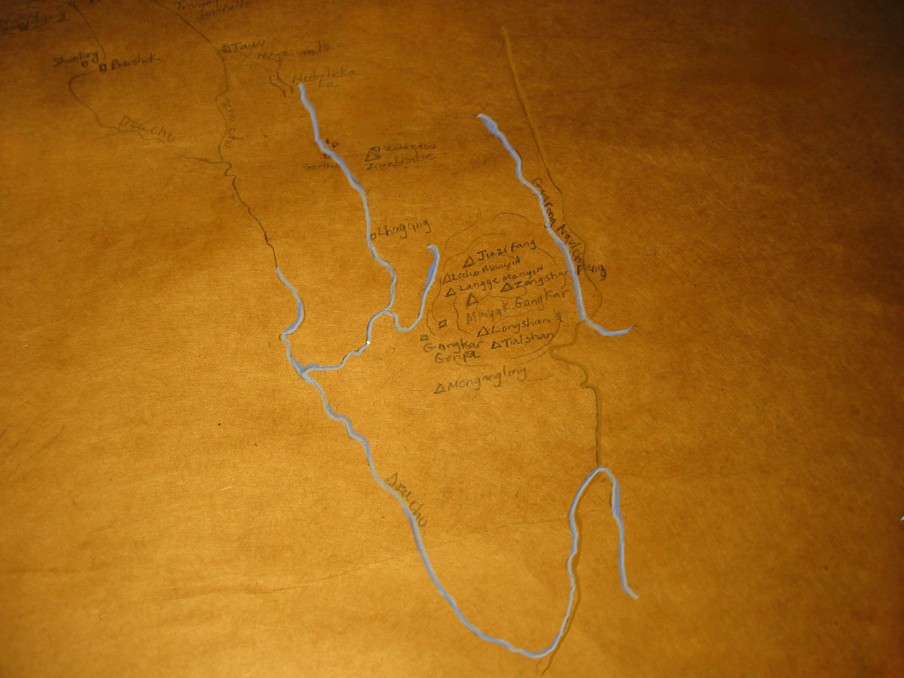
We're in our coracle heading toward Gangkar Gonpa and the Minyak Rabgang mountains! I'm not sure what the river is we are on; it may be named the Tung chu. It flows into the Yalong Dza chu though. I've shown a bit more of the Dza chu so we can get a sense for where we are. We're fairly close to China here! The Dza chu actually forms the boundary between Tibet and the Sichuan province of China a bit south of the Minyak Rabgang. There are many more mountains in this range than I mentioned in the poem. Twenty of them are higher than 6000 metres or about 20,000 feet which is a thousand times higher than our precious snow mountain! From them 45 glaciers make their way down to the valleys below. The one I described ,the Hailougou is at 10km or a bit over six miles, the largest of these; it extends from the heights of Minyak Gangkar down to 2600 meters. I've seen pictures of such glaciers and it is sort of fascinating. They seem very incongruous when seen at low elevations especially in forested areas, almost as if they were some primordial being resting among the trees. Perhaps on the energetic level they are! I haven't read of any Tibetan legends describing deities of glaciers yet though. Pilgrims don't generally travel much higher than the base camp at Gangkar Gonpa. Actually, prior to the arrival of westerners Tibetans did not attempt to climb the great snow peaks since they viewed them as sacred and generally saw no reason for it! There are several monasteries in the area. The Gangkar Gonpa is as I mentioned, of the Kagya lineage. Giwaka Jampaling is of the Gelukpa faith and was founded by a student of the second Dalai Lama named Lama Gangringpa. Our Footprint Tibet handbook also mentions Nego, Tongku, and Chukmo which were smaller Kagyu monasteries which later became part of the Geluk and Sakya lineages. There's a lot more to add but as usual two as one we'll add to the notes later beautiful one!

* courtesy of A Luminous Diamond (Bright) Crystal Show productions. The information for
the sketches is courtesy of the Footprint Tibet handbook by Gyurme Dorje.
 ( please click here to return to my spinning for you!)