
Through My Eyes
*
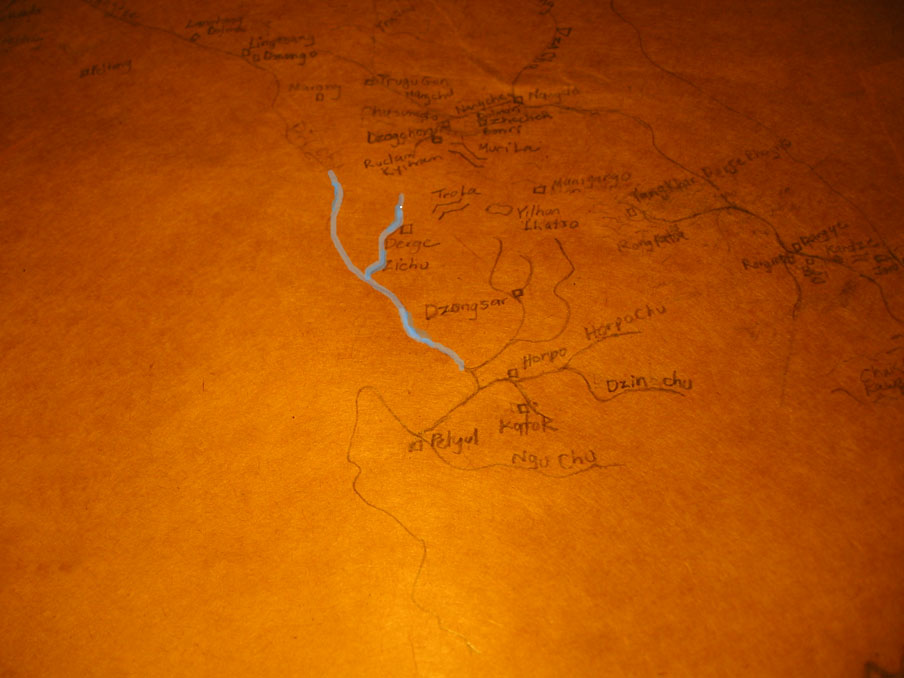
We're in our coracle on our way to rest at Derge and the Derge Parkhang again! We're going to watch the printing process again to figure out how to work on the printing block for the prayer flag. The three stories of the Derge Parkhang are actually made of compacted earth walls which have been placed on top of a stone foundation; this is a fairly typical method of building in Tibet. There certainly are a lot of blocks there! Our Footprint Tibet handbook doesn't mention how many but from other sources we know that there are well over 200,000 of the text blocks. There are also a few thousand blocks used to create images of various deities. We can see some Tibetans painting the text or images onto handmade paper to begin the process. Then the paper is glued to a smoothed block of hardwood in a reversed position. The carvers can then follow the outlines to carve the printing block itself. The process takes tremendous skill and the smoothness of the lines is wonderful to look at! I'm yet not certain if the blocks are put into a press or if the paper is pressed on top of the inked block with a padded tool as is sometimes done. The wood itself has to be hard enough to carve crisply and strong enough to survive many printings yet at the same time not so hard as to require constant resharpening of the tools. In some places blocks of particularly dense wood are soaked in oil to make them more useable; perhaps this is done in Derge. In any case the craftspeople of Derge were renowned for their metal work so they were probably quite adept at making the special gouges and chisels needed to do the carving. Outside of the Parkhang the Tangyel Lhakhang dedicated to Tangtong Gyelpo and the Derge Gonchen are not far away as we know well! In Derge there is also a building where traditional Tibetan medicines are made from the herbs, minerals, and other substances from all parts of the Chuzi gangdruk! In some cases Tibetans have actually increased their prosperity by acting as merchants selling healing plants and fungi in markets of Sichuan many of which are used in Japan and China for highly sought after traditional remedies. There's a lot more to add but as usual two as one we'll add to the notes later beautiful one!

* courtesy of A Luminous Diamond (Bright) Crystal Show productions. The information for
the sketches is courtesy of the Footprint Tibet handbook by Gyurme Dorje.
 ( please click here to return to my spinning for you!)