
Through My Eyes
*
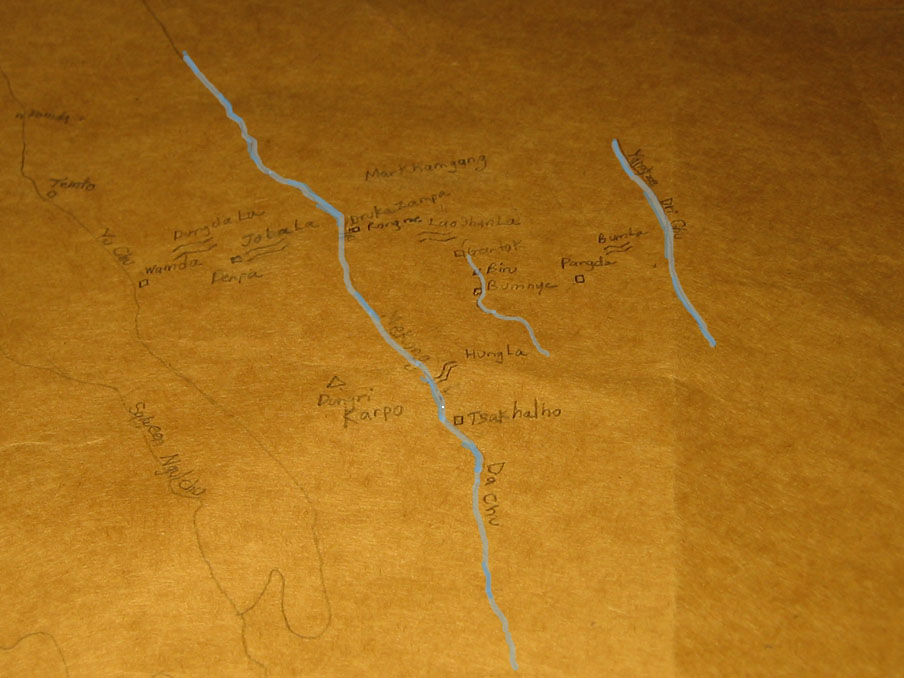
We're in our coracle on the Mekong Da chu on our way to the salt pans of Tsakhalho! I'm somewhat mystified as to where the brine comes from though. Perhaps the rocks here are high in salt or there is a salt lake nearby. Our Footprint Tibet handbook doesn't mention it but we're about to find out! I'm not certain how Tibetans work the salt pans although it may be similar to other places where they have a sort of scraper with a long handle that they push along the bottom to scrape the salt crystals off as they form in the slowly evaporating water. We've travelled almost to the Yangtze Dri Chu and Bum la pass before returning toward the Mekong Dza chu! I've shown the Drong chu flowing below Gartok at least as best as I can tell from the drawings in our Footprint Tibet handbook. I haven't been able to find anything about Pangdatsang although we do know that the family descending from Pandatsang was a wealthy aristocratic family of Tibet. Most likely it was like another family the Lakar sang famous for centuries for it's generosity to the Buddhism both in contributions and in effort; some of the great practitioners came from such families! Anyway we've spent a bit of time on the Bum la pass that as I mentioned in the poem was regarded by the Qing dynasty as the boundary between independent Tibet and Tibet under the control of the Qing emperors and empresses. The Qing dynasty was the last dynasty of China prior to the establishment of the People's Republic of China. Our Footprint Tibet handbook describes some of it's interference with the government in Lhassa. In particular the Chinese ambassadors were known for arranging the assassinations of the Dalai Lama's before they were old enough to take control from the regents. Then the ambans, as the Manchu ambassadors were called, would then try to control the regent. It wasn't until the thirteenth Dalai Lama , the "Great Thirteenth" as he was called, that the Dalai Lama was actually influential in the affairs of the country. In Kham chinese warlords attempted to hold territories but were fiercely resisted and the Chinese had little actual power there. Anyway, through the centuries Tsalkalho was a place on the trading route that lead from Lijang and Dechen of south eastern Tibet to Lhassa.The salt would have been an important trading item there! There's a lot more to add but as usual two as one we'll add to the notes later beautiful one!

* courtesy of A Luminous Diamond (Bright) Crystal Show productions. The information for
the sketches is courtesy of the Footprint Tibet handbook by Gyurme Dorje.
 ( please click here to return to my spinning for you!)