
Through My Eyes
*
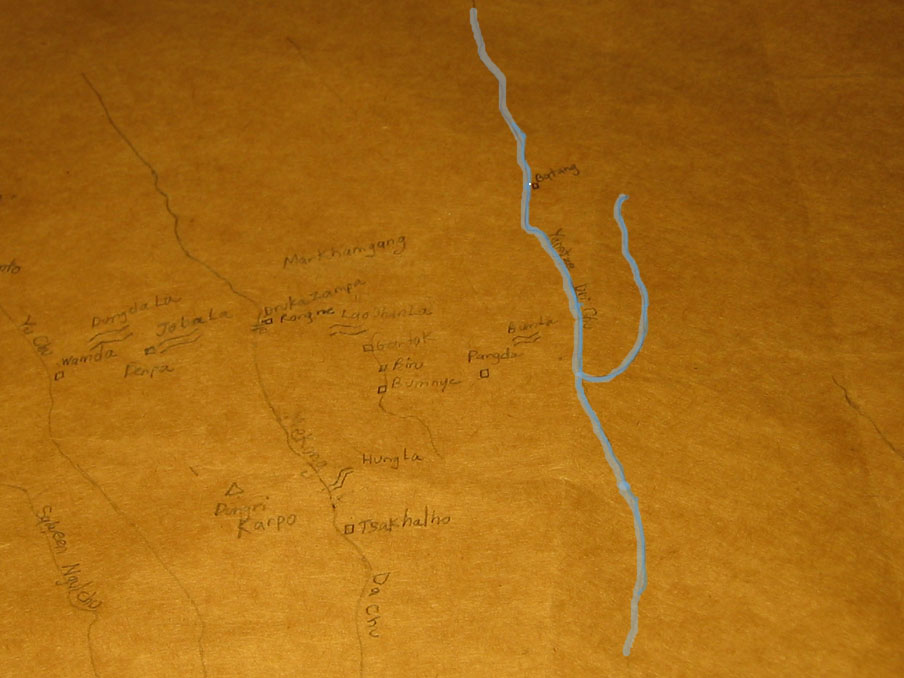
We're in our coracle on Yangtze Dri chu at Batang Jakhyung about to enter the Batang Chode! I tried to bring us the sense of what it must have been like in the conflict when the Chinese invaded in the early part of the twentieth century. Looking down on this region from above we can get a sense the need behind the Manchu government's attempt to form a territory here. The southern portions of the rivers of the Chuzi gangdruk as we know are fairly low altitude. The land is much more fertile here and the climate more hospitable than other areas of Tibet. The same is true of the Konpo region nearby where the Brahmaputra winds its way between Namchak Barwa and Gyala Pelri on it's way to India and the Ganges. We know of this region already! China already had a very large population and it's need was so great that millions of people settled in perilous areas simply because the land was fertile enough to sustain them such. One example is the Yellow River. The Yellow River ,the Ma chu has a very fertile valley but it's headlands are composed of a loess soil that causes it to fill with sediment rapidly. The inhabitants would build up dikes along its banks to keep it from flooding. Then the Ma chu would fill in some more, the inhabitants would raise up the dikes some more until the river was flowing tens of feet above the houses! Occasionally the river would break though the dikes with unimaginably horrible results. In the 1940s, I believe that was the time, this occurred and over a million people died immediately. In the years that followed another three million died from starvation and disease. This has occurred many times in the history of China. Most likely such a flood caused the famine the Dalai Lama described when he told of the Chinese couple with the dead baby who came begging for food from his mother. Anyway, you can imagine the intensity of the fighting that must have took place near Batang Jakhyung and the rest of Chuzi gangdruk! The Tibetans drove the Chinese back as we know but Batang continued to have a Chinese settlement and many of the Bapa, Tibetans who lived here, got high positions in the government following the invasion of the PLA because, unlike many Tibetans, they already knew the Chinese language. Our Footprint Tibet handbook indicates that the Batang Chode, of the Gelukpa lineage was among the places destroyed by the fighting with the armies of Chao Erh Feng and that it took a few decades to rebuild it. It's as I described except we've also to see the Tsuklakhang or large temple, in the left corner of the courtyard that the high gate opens onto. It may be that the other things I described were in the Tsuklakhang. There's a lot more to add but as usual two as one we'll add to the notes later beautiful one!

* courtesy of A Luminous Diamond (Bright) Crystal Show productions. The information for
the sketches is courtesy of the Footprint Tibet handbook by Gyurme Dorje.
 ( please click here to return to my spinning for you!)