
Through My Eyes
Saturday April 17
(We continue to listen to the Dalai Lama as he describes his instituting reforms.)
" Not long after the Panchen Lama's visit, I was invited back to the Tathag monastery, where I consecrated, very elaborately and thoroughly, in a ceremony lasting fifteen hours, the stupa (memorial) dedicated to my guru. I felt quite sad as I prostrated full length in front of it. Afterwards, I went on an excursion into the mountains and surrounding area, relieved to be free from the pressures of our unhappy situation. One interesting aspect of this visit was being shown a piece of Tathag Rinpoche's skull that had survived the flames of cremation. On it could clearly be seen an imprint of the Tibetan character that corresponded to his protector divinity. Actually, this mysterious phenomenon is quite common amongst high lamas. The bones melt in such a way as to reveal characters, or sometimes images. In other cases, such as that of my predecessor, those imprints can actually be observed on the body itself.
After the forced resignations of Lukhangwa and Lobsang Tashi in early spring,1952, there followed a period of uneasy truce with the Chinese authorities. I used this as an opportunity to establish the Reform Committee that I had had in mind since the journey to Dromo more than a year before. One of my main ambitions was to establish an independent judiciary.
As I have mentioned in the case of Reting Rinpoche, I was impotent as a minor to help people when they fell foul of the Government, though I should often have liked to. For example, I remember with sadness the case of a man who worked in the administration, discovered hoarding gold-dust which was intended for use in making thangkas. I watched him through my telescope having his hands bound and then being set on a mule facing backwards and banished from the city. This was the traditional punishment for such crimes.
Sometimes I feel that I could have intervened more often. There was another similar incident that I witnessed at the Potala. From very early on I had identified several places where it was possible by peeping through windows or skylights, to observe what was going on in rooms that I would not otherwise have seen inside. On one occasion, I saw by this means a hearing of the Regent's Secretariat which had met to consider the grievance of a certain tenant against his landlord. I clearly remember how poor and miserable this poor man looked. he was quite elderly, short and bent, with grey hair and a thin moustache. Unluckily for him, his master's family was friendly with the Regent's (at the time still Reting Rinpoche) and his case was dismissed. My heart went out to him, but there was nothing I could do. So now, as I heard of similar cases of injustice, I became ever more convinced of the need for judicial reform.
I also wanted to do something about education. At the time, there was still no system of universal education. There were only a few schools in Lhasa and a tiny handful in rural areas, but for the most part the monasteries were the only centres of learning, and the education they provided was open only to the monastic community. Accordingly, I instructed the Kashag to put forward proposals for the development of a good educational programme.
Another area which I felt was in urgent need of reform was commmunications. In those days,there was not a single road in all Tibet and almost the only wheeled vehicles were the Thirteenth Dalai Lama's three cars. It was easy to see that many people would benefit enormously from a system of roads and transportation. But, like education, this was a long-term consideration and I realised that it would be many years before there could be progress there.
However, there were things that could be done which would bring immediate positive results. One was the abolition of inheritable debt. This, I had gathered both from my sweepers and from my talks en route to Dromo, was the scourge of the peasant and rural community in Tibet. It meant that debt owing to a landlord by his tenants, perhaps acquired as a result of successive bad harvests, could be transferred from one generation to the next. As a result, many families were not able to make a living for themselves, let alone hope one day to be free. Almost as pernicious was the system whereby small landowners could borrow from the Government in times of need. Here too the debt was inheritable. So I decided firstly to abolish the principle of hereditary debt and secondly to write off all government loans that could not be repaid.
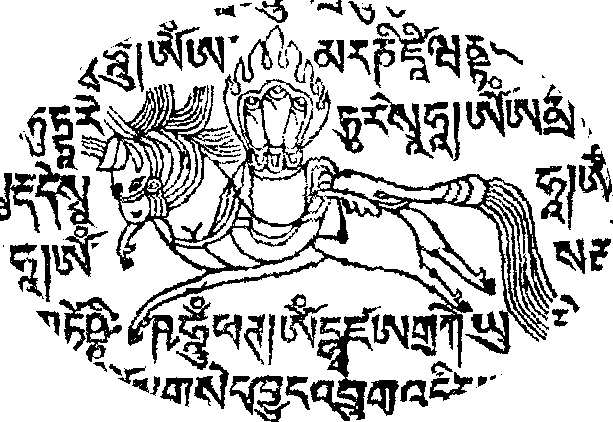
Knowing that these reforms might not be very popular with the nobility and people with vested interests, I persuaded the Lord Chamberlain to issue these decrees publicly, not in the usual way by putting up the posters in public places. Instead I had them distributed on paper that was printed on wooden blocks similar to those used for printing scripture. That way, there was a better chance the information would be widely disseminated. Anyone who might otherwise have tried to interfere would with any luck not have their suspicions raised until it was too late."
( No institution is perfect and certainly the Tibetan social order had many problems; it was sad though that the reforms came after the Chinese invasion since the result would have been an ideal society. I promise to add more tomorrow...)
 *( please click here to read of the day with me )
 * This is from the book Freedom in Exile The Autobiography of the Dalai Lama by Tenzin Gyatso, the fourteenth
Dalai Lama of Tibet.


 ( Please see my spinning for you!) ( Tahshi Deleh gentle one! Kehrahng kusu debo yinpeh? I started the day working on the water system and succeeded in completing this. We now have water in the Grove again; with us working two as one together it went quite well! The drip irrigation isn't set up but it's not needed until later in the season which is good because I have to fix some of the lines. The lawnmower may be needed in spots even though I don't like using it up there because the scythe tends to get caught on the tubing which slices holes in it. I have a hand push mower but it's rough and there's a lot of area to cover! After that I returned to our studio to work on your loom. This next attempt is going quite well too and the threads should work much more easily this time. I'm going to working on a narrower section first to make certain. I hope you liked the picture of me from our sacred place. As usual the studio picture was hard to set up; I would have liked you to have seen the spindle and a few other details but I know you understand. Tomorrow hopefully we'll start working again on the monthly pages. I would have liked to have done some drawing today but there just hasn't been enough time! I notice I forgot to note that last Friday was the fifteenth month since our prayer flag first rose to the wind! You noticed though I think! Our commitment to each other is a great source of strength and hope to me beautiful one. I'm going to put the pages on our infosite;I'll put this up so we can rest.
 And so, as always we'll continue two as one on to tomorrow
my one gentle beautiful patient swift dream bright
long dark mane in sunlight
so for now I bid goodnight...Simjah Nahngo!)