
Through My Eyes
Saturday April 24
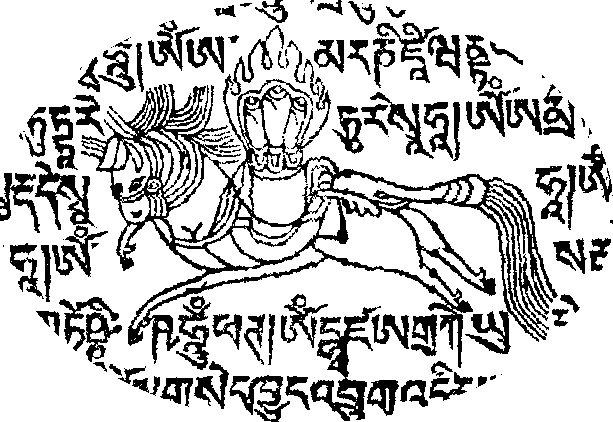
(We continue to listen to the Dalai Lama as he tells of the Kalachakra Mandala!)
" The terms of the Seventeen-Point 'Agreement' made it clear that 'the Local Government of Tibet shall carry out reforms of its own accord' and that these would not be subject to 'compulsion on the part of the authorities [i.e. the Chinese]'. However, although these early attempts at land reform brought immediate benefit to many thousands of my people, it soon became clear that our 'liberators' had an altogether different approach to the organisation of agriculture. Already, collectivisation had begun in Amdo. Eventually, it was introduced throughout Tibet and was directly responsible for widespread famine and the deaths of hundreds of thousands of Tibetans from starvation. And although the authorities relented following the Cultural Revolution, the effects of collectivized farming are felt to this day. Many visitors to Tibet have commented on how small and underdeveloped the people in rural areas look, due to malnutrition. But all this lay in the future. In the meantime, I urged the Government to do all it could to rout out old and unproductive practices. I was determined to do all I could to propel Tibet into the twentieth century.
During the summer of 1953, so far as I can remember, I received the Kalachakra initiations in the Tantric tradition, with special significance for world peace. And, unlike other Tantric rites, it is given before large public audiences. It is also very elaborate and takes a week to ten days to prepare, as well as three days actually to perform. One of its features is the construction, using individual grains of coloured sand, of a large mandala, a representation in two dimensions of a three-dimensional symbol. The first time I ever saw one of these mandalas, I almost lost my balance from just looking at it , so extraordinarily beautiful did it appear.
The initiation itself followed a month-long retreat. I recall it as a very moving experience that affected both Ling Rinpoche and myself. I felt extremely privileged to be participating in a tradition performed over countless generations by successions of highly realised spiritual masters. Whilst chanting the last verse of the dedication prayer, I was so moved that I choked with emotion, a fact that subsequently I came to regard as having been auspicious, though I thought nothing of it at the time. I now see it as being premonitory of my being able to give many more Kalachakra initiations than any of my predecessors, and in all parts of the world. This, despite my being by no means the most qualified to do so.
The following year, during Monlam, I received full ordination as a Buddhist bikshu in front of the statue of Chenrezig in the Jokhang temple. Again this was a very moving occasion, with Ling Rinpoche officiating. Then, that summer, at the request of a group of lay women, I performed the Kalachakra initiation ceremony for the first time during this lifetime.
I was very glad for this period of fragile rapprochement with the Chinese authorities. I used it to concentrate on my religious duties and began to give regular teachings, to both small and large groups. As a result, I began to build up a personal relationship with my people. And although at first I was somewhat anxious to be addressing public audiences, my self-confidence rapidly increased. I was aware, however, that outside Lhasa the Chinese were making life very hard for my people. At the same time, I could see for myself why my two Prime Ministers had been so scornful of the Chinese. For example, whenever General Chiang Chin-wu came to see me, he posted body guards outside the room-even though he must have known that sanctity of life is one of the cardinal rules of Buddhism.
Still, I took note of the Buddha's teaching that in one sense a supposed enemy is more valuable than a friend, for an enemy teaches you things, such as forbearance, that a friend generally does not. To this I added my firm belief that no matter how bad things become, they will eventually get better. In the end, the innate desire of all people for truth, justice and human understanding must triumph over ignorance and despair. So if the Chinese oppressed us, it could only strengthen us."
( Alas the time for things to get better in Tibet seems to be many generations at this rate. I promise to add more tomorrow...)
 *( please click here to read of the day with me )
 * This is from the book Freedom in Exile The Autobiography of the Dalai Lama by Tenzin Gyatso, the fourteenth
Dalai Lama of Tibet.

 ( Please see my spinning for you!) ( Tahshi Deleh gentle one! Kehrahng kusu debo yinpeh? After the arrival of a delivery of more tree food I headed up to the Grove to scythe near the trees. The Grove is quite beautiful now with different parts coming into bloom. Two as one we've gotten a lot done and have almost completed this. The grass is growing fast though! After that I rested by your Medlar tree a bit which looks wonderful! I've taken a picture to bring to us tomorrow. After that I returned to our studio to work on a bit on your loom and our a land of Tibet. I'm going to put the pages on our infosite;I'll put this up so we can rest.
 And so, as always we'll continue two as one on to tomorrow
my one gentle beautiful patient swift dream bright
long dark mane in sunlight
so for now I bid goodnight...Simjah Nahngo!)