
Through My Eyes
*
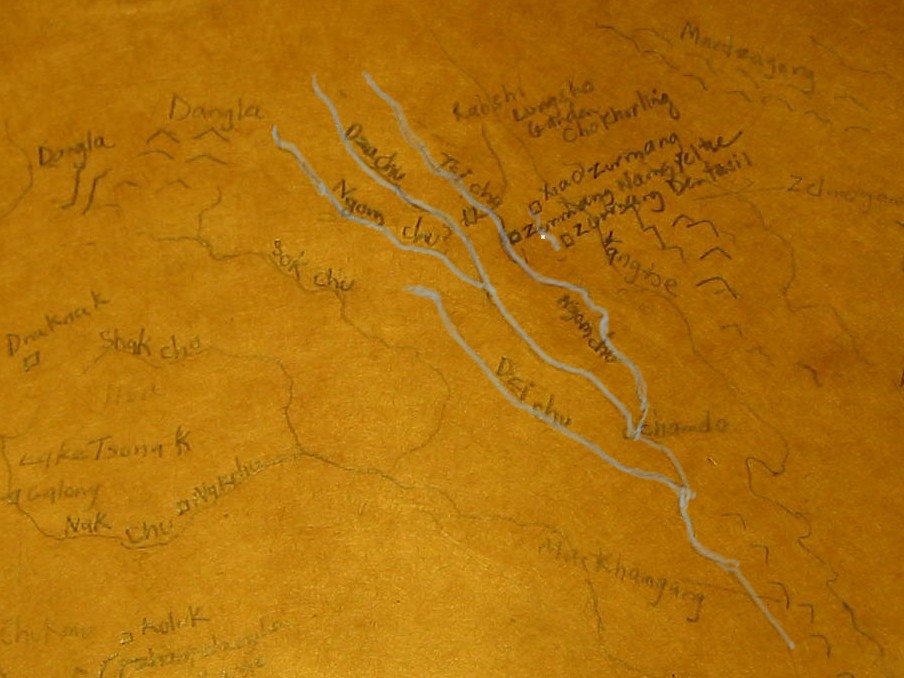
We're in our coracle in the Kyang-chu on our way to a small narrow gorge! It's a wondrous place with an abundance of medicinal herbs and flowers; the spirits must be strong here. Perhaps there are even plants to dye fabric! Anyway, the Kyang-chu is one of the rivers that combine to give rise to the Da chu, the Mekong. I'm not sure where all of them are yet but there are five of them: the Ngom chu, Do chu, Dza chu, Tsi chu, and the Kyang chu. Our Footprint Tibet handbook has the Ngom chu marked in a few spots; I' m not sure of this. The gorge is just a bit to the west of the Kyang chu beyond some pasturelands that have magnificent herds of yak and dri roaming about! This is just a bit north of Zurmang Dutsitil a monastery of the Karma Kagyu school one of the major lineages of Buddhism in Tibet. It has beautiful murals! Kham is a good place to learn of the spiritual traditions because all of them are well represented along with the Bon faith that we know preceded Buddhism. What a spirited fascinating place this is! Anyway the Karma Kagyu or Kagyupa school was based on the teachings of the masters from India and was brought into Tibet by Marpa Lo-tsawa and Zhang Tselpa in the 11th and 12th centuries. Marpa's student was none other than the renowned Milarepa who was the one that lived on nettles and encountered the demons that we learned of earlier. There are many stories about him! This may be the best way to understand these lineages, by stories of the different teachers of each one. The actual spiritual techniques seem rather complex to understand. Karma Kagyu was quite strong in the kingdom of Nangchen which is where Lhalung Pelgyi Dorje fled I'm guessing on the route from Lhassa over Nyenchen Tanglha then on over the Danglha mountains and the Salween to finally end up along the Tsi chu where Rabshi Lungsho Ganden Chokhorling now stands. There's a lot more to add but as usual two as one we'll add to the notes later beautiful one!

* courtesy of A Luminous Diamond (Bright) Crystal Show productions. The information for
the sketches is courtesy of the Footprint Tibet handbook by Gyurme Dorje.
 ( please click here to return to my spinning for you!)