
Through My Eyes
Saturday April 23
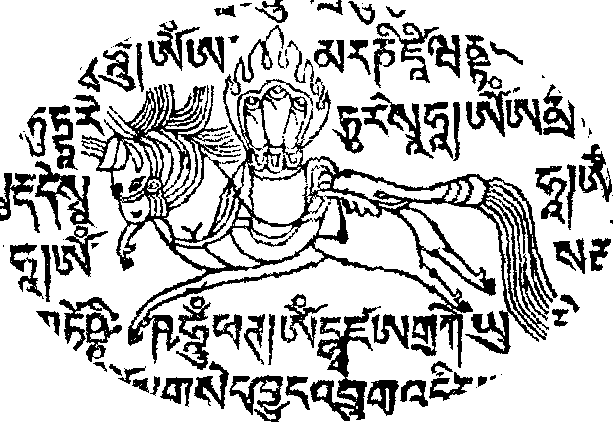
(We continue to listen to the Dalai Lama as he tells the terribly sad fate of the Tibetan resistance.)
" As a result, the would-be insurgents endured many difficulties, though of course nothing compared with the dangers faced by the many extraordinarily brave freedom fighters who carried on the struggle from inside Tibet itself.
When the base finally became operational, the guerrillas harassed the Chinese on a number of occasions and once managed to destroy a convoy. it was this raid which captured the document recording the 87,000 deaths in Lhasa during the period March 1959-September 1960. These successes had some positive result in that they boosted morale. But the fact that there was no consistent, effective follow-up probably only resulted in more suffering for the people of Tibet. Worse, these activities gave the Chinese Government the opportunity to blame the efforts of those seeking to regain Tibetan independence on the activities of foreign powers- whereas, of course,it was an entirely Tibetan initiative.
In the end, the Americans discontinued their backing for the guerillas following their recognition of the Chinese Government in the 1970's- which indicates that their assistance had been a reflection of their anti-Communist policies rather than genuine support for the restoration of Tibetan independence.
The guerillas, however, were determined to fight on. This caused the Chinese Government ( who must have been considerably troubled by their activities) to demand that Nepal disarm the forces in Mustang, even though there must have been some arrangement between these Tibetans and the Nepalese Government. But when they tried to do so, the guerillas refused, saying that they were determined to carry on even if it meant that they must now fight the Nepalese army as well.
Although I had always admired the determination of the guerillas, I had never been in favour of their activities and now I realised that I must intervene. I knew that the only way I could hope to make an impression on them was by making a personal appeal. Accordingly, I instructed former Kusun Dpon P.T. Takla to take a taped message to their leaders. In it, I said that it would be senseless to fight the Nepalese, not least because there were several thousand Tibetan refugees settled in Nepal who would also suffer if they did. Instead they ought to be grateful to the Nepalese Government. They should therefore lay down their arms and themselves settle peacefully. The Tibetan struggle needed a long term approach.
Afterwards, P.T. Takla told me that many of the men felt that they had been betrayed- a few of their leaders actually cut their own throats rather than leave. I was distraught to hear this. Naturally I had had mixed feelings about appealing to the freedom fighters. It seemed wrong in a way to challenge such courage, such loyalty and such love for Tibet, though I knew in my heart that it was the right thing to do.
The great majority of the guerillas did put down their weapons. But some of them, less than a hundred, ignored my plea, with the result that they were pursued by the Nepalese army as they crossed from one side of the border to the other. Finally, they were caught in an ambush and met the violent deaths they must have been expecting. Thus ended one of the saddest episodes in the history of the Tibetan diaspora.
I made my first journey outside India during the autumn of 1967, when I went to Japan and Thailand. Since the, I have travelled with increasing frequency- this despite the difficulties often imposed by my brothers and sisters in China. Unfortunately, although the great majority of my journeys overseas are entirely private (generally at the invitation of one of the Tibetan or Buddhist communities abroad), the Chinese always consider them to be political, and anyone who meets me is seen by the authorities in Peking to be making a political statement. For this reason, there have been times when leading public figures have been prevented from making my acquaintance for fear of incurring their government's or China's displeasure.
At the time of those first visits, the Vietnam War was at it's height. I recall that at one point on the flight out, as we cruised at high altitude, I noticed another, larger aircraft climbing past us. I recognised it as a B-52 bomber. With great sorrow I realised that this plane must be about to shed its load not harmlessly over the sea but no to other human beings like myself. I was further dismayed to see that, even at 30,000 feet above the earth's surface, it is not possible to escape evidence of man's inhumanity to man.
On landing in Tokyo, I was pleased to find signs of man's better nature. The first thing I noticed was an extraordinary tidiness. Everything was far cleaner that I had ever seen before."
(That a great leader of one of the most peaceful nations on earth in exile was regarded as an embarrassment is a lasting mark of shame upon the nations of this world. I promise to add more tomorrow...)
 *( please click here to read of the day with me )
 * This is from the book Freedom in Exile The Autobiography of the Dalai Lama by Tenzin Gyatso, the fourteenth
Dalai Lama of Tibet.

 ( Please see my spinning for you!) ( Tahshi Deleh gentle one! Kehrahng kusu debo yinpeh? I began the day in our studio spinning for you then worked on the printing block which with we two working as one pulling strongly and patiently together is going quite well! Since it was raining I then worked on the monthly pages. Two as one we've almost completed the pages for February and March! I've put them up for us to look over as usual. After that I wandered around outside our studio taking pictures before heading up gang rinpoche ngah tso gi to check the trees and native plants. It looks wonderful up there even now! I'm going to take lots more pictures soon to bring us when the weather clears a bit. After that I rested by your Medlar tree as usual before returning to our studio to work on our a land of Tibet. I'm going to put the pages up on our infosite; I'll put this up for now so we can rest.
 And so, as always we'll continue two as one on to tomorrow
my one gentle beautiful patient swift dream bright
long dark mane in sunlight
so for now I bid goodnight...Simjah Nahngo!)