
Through My Eyes
Saturday October 11
(We continue listening to the Dalai Lama tell of his life at the Potala! )
" At the Potala, I used to get up at around six o'clock in the morning. After dressing, I undertook a short period of prayer and meditation, which lasted about an hour. Then, just after seven, my breakfast was brought in. This invariably consisted of tea and tsampa,with honey or caramel. I then had my first period of study with Kenrap Tenzin. After I had learned to read and until I reached the age of thirteen, this was always penmanship. There are two principal scripts for the Tibetan language, Uchen and Ume. One is for manuscripts and the other for official documents and personal communications. It was only necessary for me to know how to write Ume, but as I learned quite quickly I taught myself Uchen as well.
I can't help laughing when I think back on these early morning lessons. For whilst I sat under the attentive eye of my Master of the Robes, I could hear my Master of the the Ritual next door chanting his prayers. The 'schoolroom' was actually just a veranda, with rows of potted plants, situated adjacent to my bedroom. It was often quite cold there, but it was light and offered good opportunities to study the dungkar, small, black birds with a vivid red beak that used to build their nests high up in the Potala. Meanwhile, the Master of the Ritual sat in my bedroom. Unfortunately, he had a habit of falling asleep whilst reciting these morning prayers. When this happened, his voice trailed off rather like a gramophone player running down when the electricity has failed as his chanting turned to a mumble and finally stopped. Then there would be a pause until he woke up, whereupon he would start up again. Only then would he get into a muddle as he wouldn't know where he had left off, so quite often he repeated himself several times over. It was very comical. But there was a good side to this. When eventually I came to learn these prayers myself, I already knew them by heart.
After penmanship came memorisation. This simply consisted of learning a Buddhist text for recital later on in the day. I found this very boring as I learned fast. I should say , though, that I often forgot just as quickly.
At ten o'clock came a respite from the morning's lessons when there was a meeting for members of the Government, which I had to attend even at a very young age. From the beginning, I was groomed for the day when, in addition to my position as spiritual leader of Tibet, I would assume temporal leadership as well. At the Potala, the assembly hall where this took place was next door to my room: the officials came up from the government offices which were on the second and third floors of the building. The meetings themselves were quite formal occasions-during which the people's duties for the day were read out to them-and, of course,protocol regarding myself was strictly observed. My Lord Chamberlain, the Donyer Chenmo, would come to my room and lead me to the hall where I was greeted first by the Regent and then the four members of the Kashaq, each according to rank.
After the morning meeting with the Government, I returned to my rooms for further instruction. I was now joined by my Junior Tutor, to whom I recited the passage I had learned during the period of memorisation that morning. He then read out to me the text for the next day, explaining it to me in detail as he went along. This session lasted until around noon. At this point, a bell was rung ( as it was every hour-except once when the ringer forgot so he rang it thirteen times!). Also at noon, a conch was blown. Then followed the most important part of the young Dalai Lama's day: play.
I was very fortunate in that I had quite a good collection of toys. When I was very young, there was an official at Dromo, a village on the border with India, who used to send up imported toys to me, along with boxes of apples when they were available. Also, I used to be given gifts by the various foreign officials who came to Lhasa. One of my favourites was a Meccano set given to me by the head of the British trade Mission, which had an office in the capital. As I grew older , I acquired several more sets of Meccano until by the time I was about fifteen I had them all, ranging from the easiest to the most difficult."
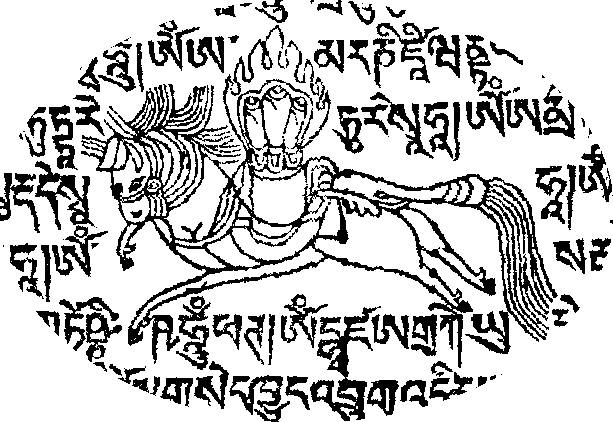
( I started to bring us the script awhile back as you remember; the one I was using is probably Ume. I promise to add more tomorrow...)
 *( please click here to read of the day with me )
 * This is from the book Freedom in Exile The Autobiography of the Dalai Lama by Tenzin Gyatso, the fourteenth
Dalai Lama of Tibet.

 ( Please see my spinning for you!) ( Tahshi Deleh gentle beautiful one! Kehrahng kusu debo yinpeh? I spent the whole day in the Grove! I began resting by your Medlar tree studying from our Tibetan language book and playing the flute a bit to please the spirits there. Then I continued cleaning around the trees and native plantings and brought down the hoses to the shed by the studio. It took a while; there were a lot of them! While not our warm and bright future day, it was beautiful up there! I notice I've made a few more mistakes yesterday which I've fixed. And so our song goes on gentle beautiful one! I'll put this up for now so we can rest.
 And so, as always we'll continue two as one on to tomorrow
my one gentle beautiful patient swift dream bright
long dark mane in sunlight
so for now I bid goodnight...Simjah Nahngo!)