
Through My Eyes
Saturday October 18
(We continue listening to the Dalai Lama as he describes life at the Potala! )
" When I was seven years old, a deputation of two American officials came to Lhasa. They brought with them, in addition to a letter from President Roosevelt, a pair of beautiful singing birds and a magnificent gold watch. These were both welcome presents. I was not so impressed with the gifts brought to me by visiting Chinese officials, however. Bolts of silk were of no interest to a small boy.
Another favourite toy was a clockwork train set. I also had a very good set of lead soldiers, which ,when I was older, I learned to melt down and recast as monks.In their original form, I enjoyed using them in wargames. I used to spend ages setting them out. Then, when battle was commenced, it took only minutes to devastate the beautiful formations that I had arranged them in. The same went for another game which involved making tiny models of tanks and aeroplanes from tsampa dough, or pa, as it is properly known.
First of all, I would hold a competition amongst my grown-up friends to see who could produce the best models. Each person was given an equal amount of dough and allowed , say, half an hour to build an army. I then judged the results. There was no danger of losing this stage of the game as I am quite dextrous. Often I would disqualify the others for making such bad models. I would then sell some of my models to my opponents for twice as much dough as it took to make them. In this way I contrived to end up with much the strongest forces and at the same time I was able to derive satisfaction from bartering. Then we joined battle. Up until now, I had everything my way, so this was when I generally lost. For my sweepers never gave quarter in any sort of competition. I often tried to use my position as Dalai Lama to my advantage, but it was no use. I played very forcefully. Quite often I lost my temper and used my fists, but they still did not give in. Sometimes they even made me cry.
Another favourite pursuit of mine was military drill, which I learned from Norbu Thondup, my favourite sweeper and one of those who had
been in the army. I was always so full of energy as a boy that I enjoyed anything that involved physical activity. I loved one particular jumping game-which was officially banned- which involved running as fast as you could up a board set at an angle of 45 degrees and leaping off at the top. However, my tendency to aggression did once almost get me into serious trouble. I had found an old, ivory topped swagger stick amongst my predecessor's belongings. This I took for my own. Once day, I was swinging it violently around my head when it slipped from my hand and went spinning hard into Lobsang Samten's face. He dropped to the floor with a crash. For a second I was convinced that I had killed him. After a few stunned moments, he stood up , in floods of tears and with blood pouring from a terrible gash on his right eyebrow. This subsequently became infected and took a very long time to heal. Poor Lobsang Samten ended up with a prominent mark that scarred him for the rest of his life.
Shortly after one o'clock came a light lunch. Now it so happened that, because of the Potala's position, sunlight flooded the room at midday when my morning studies ended. But by two o'clock it had begun to fade and the room fell back into shadow. I hated this moment: as the room sank back into shade, a shadow fell across my heart. My afternoon studies began soon after lunch. The first hour and a half consisted of a period of general education with my Junior Tutor. It was all he could do to hold my attention. I was a very reluctant pupil and disliked all subjects equally.
The curriculum that I studied was the same as that for all monks pursuing a doctorate in Buddhist studies. It was very unbalanced and in many ways totally inappropriate for the leader of a country during the late twentieth century. Altogether, my curriculum embraced five major and five minor subjects, the former being: logic; Tibetan art and culture; Sanskrit; medicine; and Buddhist philosophy.This last is the most important (and the most difficult) and is subdivided into a further five categories: Prajnaparamita, the perfection of wisdom; Madhyamika, the philosophy of the Middle Way; Vinaya, the canon of monastic discipline; Abidharma, metaphysics; and Pramana, logic and epistemology."
( What a day! I promise to add more tomorrow...)
 *( please click here to read of the day with me )
 * This is from the book Freedom in Exile The Autobiography of the Dalai Lama by Tenzin Gyatso, the fourteenth
Dalai Lama of Tibet. The photo of the Potala is courtesy of the Carsten Nebel website at


 ( Please see my spinning for you!.) ( Tahshi Deleh gentle one! Kehrahng kusu debo yinpeh? I tidied up in the studio for a bit in the morning and cleared a bit more in the "messy nucleus" spot. Then I went up to the Grove and continued working on our water system. It's all set now! I continued working with the trees putting on collars until it was too dark to work. Things are going well and the Grove should be ready for winter in a few more weeks. Except for the grape arbor which we'll probably end up working on later! Here is the Potala! Incredible isn't it?!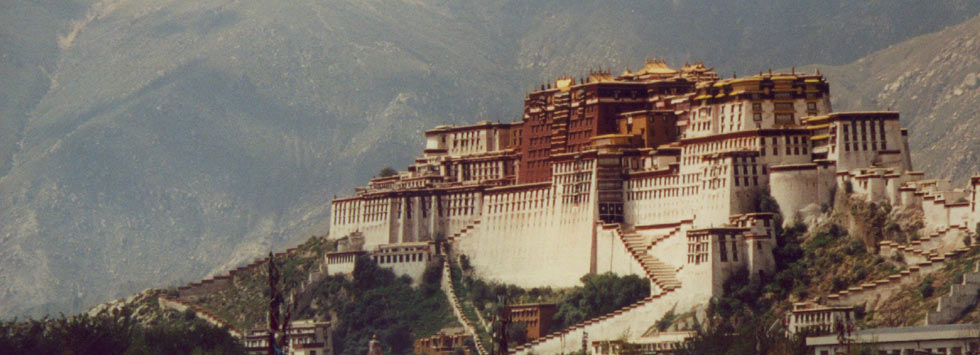
I've learned in our research a bit more about it. It has thousands of rooms most of which are no longer open for viewing. They were filled with many sacred precious things which were taken back to China. Among it's wonders is a lake with an island shrine that was created from the large pit that was dug to supply the mortar for the Potala. I'll show you that soon as we continue two as one working on a land of Tibet! I'll put this up for now so we can rest.
And so, as always we'll continue two as one on to tomorrow
my one gentle beautiful patient swift dream bright
long dark mane in sunlight
so for now I bid goodnight...Simjah Nahngo!)