
Through My Eyes
Saturday September 18
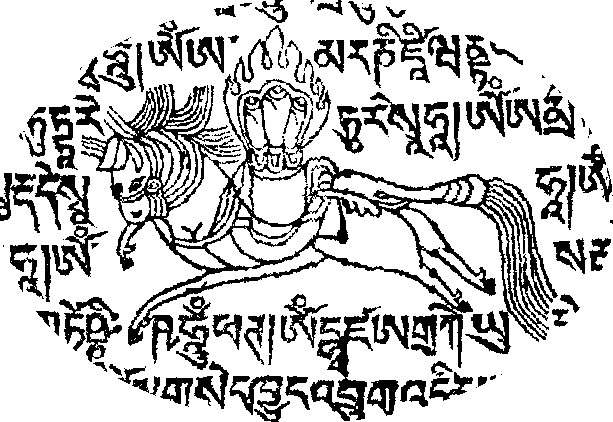
(We continue to listen to the Dalai Lama as he tells of the Chinese atrocities in Tibet.)
" The methods that the Chinese used to intimidate the population were so abhorrent that they were almost beyond the capacity of my imagination. It was not until I read the report published in 1959 by the International Commission of Jurists that I fully accepted what I had heard.
Realising that disaster was in the offing, I announced that I would present myself for my final monastic examinations during the Monlam festival of 1959, eighteen months from now. I felt that I must graduate as soon as possible, lest time run out. At the same time, I began very much to look forward to the arrival in Lhasa of Pandit Nehru, who had accepted my invitation (warmly approved by the Chinese Ambassador) to visit Tibet the following year. I hoped that his presence would compel the Chinese authorities to start behaving in a civilized way.
Meanwhile, life in the capital continued much as it always had since the Chinese first arrived six years before, although they themselves became significantly more aggressive. Form now on, whenever the Generals came to see me, they were armed. They did not wear their guns openly, however, but concealed them under their clothes. This forced them to adopt very awkward positions when they sat down, and even then the barrels were clearly visible. When they spoke, they continued to offer me the usual assurances, but their faces betrayed their real feelings by turning the color of radishes.
Also, the Preparatory Committee continued to meet on a regular basis to discuss meaningless policy amendments. It was extraordinary to what lengths the Chinese authorities went to provide a facade behind which they could carry out their abominations elsewhere in the country. I felt powerless. Yet I was certain that if I resigned (which I did consider doing) or opposed the Chinese directly, the consequences would be devastating. And I could not allow Lhasa and those areas of Tibet tat were not so far engulfed in bloodshed to succumb as well. Already there were at least eight divisions of the PLA operating in the east: over 150,000 trained men with sophisticated battlefield technology confronting an irregular band of horseman and mountain warriors. The more I thought about the future, the less hope I felt. It seemed that no matter what I or any of my people did, sooner or later all of Tibet would be turned into a mere vassal state in the new Chinese empire, without religious or cultural freedoms, let alone those of free speech.
Life at the Norbulingka, where I stayed permanently now, also continued much as ever. The thousands of gilded Buddhas that stood flickering in the gentle light of countless butter lamps were a pointed reminder that we live in a world of Impermanence and Illusion. My routine was much the same as it had always been, although now I got up earlier, usually before five o'clock, to pray and study texts alone for the first part of the morning. Later on, one of my tutors would come to discuss the texts I was reading. Then we would be joined by my tsenshap, of which there were now four, and I spent much of the day debating- for this was how I would be examined. And, as usual, I would, on certain days of the calendar, preside over a puja in one of the many palace shrine-rooms.
Lhasa itself had changed considerably since the Chinese invasion, however. A whole new district had sprung up to accommodate the Chinese officials and their dependents. Already there was evidence of a modern Chinese city which would one day swamp the ancient capital. They had built a hospital and a new school-although I regret to say that these were of little benefit to the Tibetan population-and several new barracks. Also, in view of the deteriorating situation, the military had begun to dig trenches around their quarters and fortify them with sandbags. And now when they went out, wheras before they had felt secure enough to go in pairs (though never alone), they did so only in convoys. But my contact with this world was slight and most of my information about it came from the dismal reports brought to me by my sweepers and various officials.
In the spring of 1958, I moved into a new palace at the Norbulingka, it being the tradition for each successive Dalai Lama to found his own building within the Jewel Park. Like the others, mine was quite small and designed to be used as no more than my own personal living quarters. What made it special, however, were the modern fittings and appliances with which it was furnished. I had a modern,iron bed in place of my old wooden box; and there was a bathroom complete with running water. There was plumbing for heating it too, but unfortunately my tenure at the Norbulingka was interrupted before it could be got to work properly. Electric lighting was also fitted throughout, on both floors. In my audience-room I had chairs and tables rather than the traditional Tibetan cushions ( for the benefit of foreign visitors), as well as a large radio, a gift from the Indian Government, if I remember correctly. It was the perfect home. Outside, there was a small pond and a beautiful rockery and garden whose planting I personally supervised. Everything grows well in Lhasa and it was soon electric with colour. Altogether, I was extremely happy there, but not for long.
The fighting throughout Kham and Amdo and now central Tibet continued to gain momentum."
(I didn't want to read the specific methods the Chinese used; you understand beautiful one. I promise to add more tomorrow...)
 *( please click here to read of the day with me )
 * This is from the book Freedom in Exile The Autobiography of the Dalai Lama by Tenzin Gyatso, the fourteenth
Dalai Lama of Tibet.

 ( Please see my spinning for you!) ( Tahshi Deleh gentle one! Kehrahng kusu debo yinpeh? I began the day in our studio spinning for you then working more on the weaving. After that I headed out to prop the pump electric line above the field which was becoming covered in water! After that I wandered about taking pictures before continuing weaving in the studio and working with the grapevine bark to design the attachment for the backstrap. Two as one we've working patiently together we've figured out a few ways to do this. Then I spent a bit of time working on some of the songs we two as one have created. These are just short melodies that we are saving and can add to later. Then I continued work on our a land of Tibet. We still have the Grove pages to work on and those links to fix as you know well! Our commitment to each other is a great source of strength and hope to me. I've said that a lot this week beautiful one I know; it is the week after our giving thanks to the Tenger and spirits and I have this to be thankful for! I'm going to put the pages up on our infosite;I'll put this up so we can rest.
 And so, as always we'll continue two as one on to tomorrow
my one gentle beautiful patient swift dream bright
long dark mane in sunlight
so for now I bid goodnight...Simjah Nahngo!)