
Through My Eyes
Saturday August 27
(We continue to listen to the Dalai Lama as he tells of the visit of the representatives to Tibet! )
" Although there is often a gap between the leadership and the people in countries where there is an authoritarian government, here it seemed that the Chinese had made an altogether extraordinary miscalculation. Even though they had a highly efficient intelligence system designed to prevent this sort of thing, their assessment was entirely wrong. But what I find still more surprising is that despite these experiences, the Chinese continue to persevere with the system. So, for example, when Hu Yaobang, then General Secretary of the Chinese Communist Party and Deng's heir apparent, visited Tibet the following year, he was taken to the Chinese equivalent of a Potemkin village and completely misled. Similarly, in 1998, I was told that when a prominent Chinese leader visited Lhasa, he asked an old woman directly what she felt about the present situation in Tibet. She, of course, faithfully repeated the Party line and he duly took this to be the true feelings of a Tibetan. It is as if the Chinese authorities actually want to fool themselves. Yet surely anyone who was half sensible would realise that a person under threat of violent punishment would not reveal any negative thoughts?
Fortunately, Hu Yaobang was not entirely deceived. He publicly expressed shock at the living conditions of Tibetans and even asked whether all the money sent to Tibet had been thrown in the river. He went on to promise the withdrawal of eighty-five per cent of the Chinese cadres stationed in occupied Tibet.
Little more was heard about these proposed measures. Hu Yaobang's ascendancy did not last long and he was eventually forced to resign as General Secretary of the Chinese Communist Party. Nevertheless, I am very grateful to his memory for the great courage he displayed in admitting China's mistakes in Tibet. The fact that he did so is clear evidence that not everyone, even amongst the leadership in China, supports the Government's repressive policies abroad. But if Hu Yaobang's admission did not have a lasting impact on Tibetan affairs, the report prepared by the first delegation, after its return to Dharamsala in late December, most certainly did.
When I arrived back from two long journeys of my own ( to Russia, Mongolia, Greece, Switzerland, and finally the United States) in October 1979, the five members of the delegation returned. With them they brought hundreds of rolls of film, many hours of recorded conversations and enough general information to occupy many months of collation, distillation and analysis. They also brought back more than seven thousand letters from Tibetans to their families in exile- the first time that mail had left Tibet for more than twenty years.
Unfortunately, their impressions of the 'new' Tibet had been strongly negative. At the same time as being mobbed by tearful Tibetans wherever they went, they saw abundant evidence of the way that the Chinese authorities had ruthlessly and systematically tried to destroy our ancient culture. Moreover, they were regaled with numberless accounts of years of famine, mass starvation, public execution and gross and disgusting violations of human rights, the least of which included the abduction of children either into forced labour gangs and for 'education' in China, the imprisonment of innocent citizens and the deaths of thousands of monks and nuns in concentration camps. It was a horrific litany, graphically illuminated by dozens of photographs of monasteries and nunneries reduced to piles of rubble, or turned into grain stores or factories or cattle pens.
However, in the face of this information, the Chinese authorities made it clear they would not hear any criticism either from the delegates or any other Tibetan from the exile community. So long as we remained outside, we had no right to criticise what went on inside, they said. When Lobsang Samten told me this, I was reminded of another incident that took place during the 1950's. A Tibetan official was asked by a Chinese Party member what was his opinion of Chinese rule in Tibet. ' First let me leave the country,' the Tibetan replied,' and then I will tell you.'
Yet it is true to say that the delegation did bring back some hopeful pieces of news. For example, when they were in Peking, they met a number of young students who were being educated as Communist Party cadres. But instead of them all being blindly Marxist and proChinese policy, they turned out to be fully committed to the cause of Tibetan freedom. And, judging by the numerous instances when ordinary Tibetans, especially the young, openly defied Chinese authority to express their love and respect for the Dalai Lama, the spirit of the people was far from broken. In fact, it seemed that these desperate experiences had only served to strengthen their resolve.
Another positive event for the first delegation was its meeting, in Peking, with the Panchen Lama. He had been treated with great cruelty by the Chinese authorities and showed his five compatriots permanent marks on his body that had been inflicted with torture. He explained that after my flight into exile, his own monastery at Tashilhunpo had been left unharmed by the PLA. But after he had begun to criticise our new masters, troops were sent in. Then, during 1962, he was told to take my place as Chairman of the Preparatory Committee.He refused and, instead, sent to Chairman Mao a 70,000-character-long memorandum of complaints. "
( It is known as the 70,000 character petition. I promise to add more tomorrow...)
 *( please click here to read of the day with me )
 * This is from the book Freedom in Exile The Autobiography of the Dalai Lama by Tenzin Gyatso, the fourteenth
Dalai Lama of Tibet.

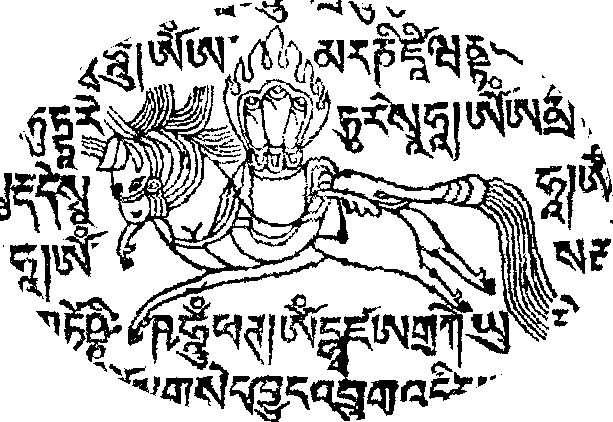
 ( Please see my spinning for you!) ( Tahshi Deleh gentle one! Kehrahng kusu debo yinpeh? I began the day in our studio spinning for you then worked on the printing block which with we two working as one pulling strongly and patiently together is going quite well! We've almost completed the carving of the sacred script; we should have it completed tomorrow! After that we'll begin working on the border and clean up the carving a bit to get it ready for printing! I hope you liked the picture of me from our sacred place. I scratched my eye on a twig a couple of weeks ago so it's a bit swollen! It's healing though. I thought I'd bring us a picture of what we've been working on in the studio since we spent the entire day there! It's a bit dark because it's easier to see the subtle plane changes in the surface of the sculpture. I thought we could create a sculpture of Tibet with Tara above looking down. It would be more of a shamanic emotional landscape that both embodied the essence of Tibet and the terrible times the Tibetan people are enduring rather than some uninteresting cartography! Anyway, with drawings and clay we've been working on some studies for it. I'm using the towel that keeps the clay moist to represent hair. You'll recognise some of yourself in them hopefully since there are elements of us both in them! This is then more work on our a land of Tibet! After that I took a nap and continued work on our a land of Tibet. Since we're talking of faces, be not concerned if you don't always see my smile for you on my face beautiful one. Sometimes it's hidden within beneath some physical uncomfortableness or mental strain. It's always there though. I'm going to put the pages up on our infosite; I'll put this up for now so we can rest.
 And so, as always we'll continue two as one on to tomorrow
my one gentle beautiful patient swift dream bright
long dark mane in sunlight
so for now I bid goodnight...Simjah Nahngo!)