
Through My Eyes
Saturday December 20
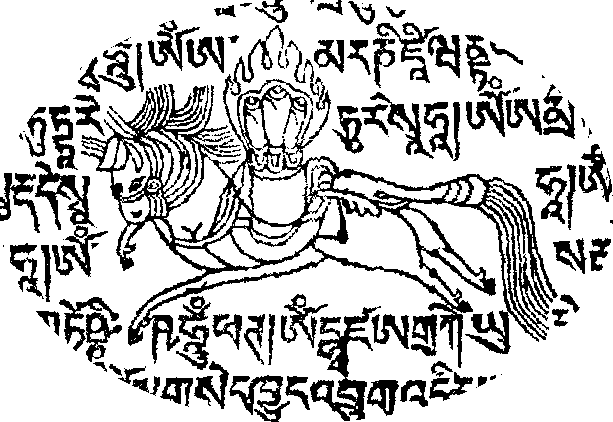
(We continue to listen to Dalai Lama as he describes the Tibetan calendar and the Johkang! )
"The Tibetan calendar is rather complicated. It is based on a lunar month. Also, rather than centuries of hundreds of years, we follow a sixty year cycle, each one of which is assigned to one of the five elements, whose order is earth, air, fire, water and iron; and one of twelve animals: the mouse, the ox, the tiger, the hare, the dragon, the serpent, the horse, the sheep, the monkey, the bird, the dog, and the pig, again in order. Each of the elements comes twice, first in its male and then in its female aspect. They thus end with the tenth year. Then the first element is joined to the eleventh, and twelfth animals, the second to the thirteenth and fourteenth animals, and so on. So for example, according to the Tibetan calendar, the year 2,000 A.D. will be the Iron Dragon year.
Throughout the centuries preceding Tibet's invasion by China, the seasons were marked by numerous festival days. Generally these had a religious significance, but they were celebrated by monks and laymen alike. For the latter, the time was passed in eating, drinking, singing, dancing and playing games, combined intermittently with prayer.
One of the most important of these events was the New Year celebration, or Losar, which comes in either February or March of the Western calendar. For me, its particular significance was my annual public meeting with Nechung, the state oracle. I shall discuss this in a later chapter, but essentially this gave me and the Government the opportunity to consult, via a medium, or kuten, with Dorje Drakden, the protector divinity of Tibet, about the coming year.
There was one festival that I had very mixed feelings about. This was Monlam, the Great Prayer Festival, which followed directly after Losar- the main reason being that as Dalai Lama, I had, even at a very young age, to participate in its most important ceremony. The other bad thing about Monlam was the fact that I invariably had to endure a severe bout of flu, just as I do today whenever I go to Bodh Gaya in India, due to the dust. This was because I took up residence in rooms at the Johkang temple, which were even more derelict than my rooms at the Potala.
The ceremony, or puja, that I feared so much took place in the afternoon, at the end of the first of two weeks devoted to Monlam. It followed a long discourse on the life of the Buddha Shakyamuni given by the Regent. The puja itself lasted for over four hours, after which I had to recite from memory a long and difficult passage of scripture. I was so nervous that I took in not a word of what came before. My Senior Tutor, the Regent, my Junior Tutor and the Masters of the Ritual, Robes and Kitchen were all equally anxious. Their main worry was that because I sat high up on a throne throughout the ceremony, no one could easily prompt me if I got stuck.
But remembering my lines was only half the problem. Because the proceedings went on for so long, I had an additional dread: I feared that my bladder might not hold out. In the end everything went well, even the first time when I was so young. But I remember being apoplectic with fear. It dulled my senses to the point where I no longer noticed what was going on around me. I ceased to be aware even of the pigeons which flew around the inside of the building, stealing from the offering plates. I only noticed them again when I was halfway through my oration.
When it was over I was ecstatically happy. Not only was the whole dreadful business over for another twelve months, but there was now one of the best moments of the Dalai Lama's year. After the ceremony I was allowed outside to walk round the streets so that I could see the thorma, the huge, gaily coloured butter sculptures traditionally offered to the Buddhas on this day. There were also puppet shows and music played by military bands and an atmosphere of tremendous happiness amongst the people.
The Johkang temple is the holiest shrine in all Tibet. It was built during the reign of King Songsten Gampo in the seventh century A.D. to house a statue brought by one of his wives, Bhrikruti Devi, daughter of the Nepalese King Anshuriaruam. Songsten Gampo had four other wives, three of them Tibetan and one Chinese, Princess Wengchen Kongjo, daughter of the second Emperor of the Tang dynasty.
Over the centuries the temple was expanded and embellished considerably. One outstanding feature of the Johkang is the stone monument which still stands at its entrance bearing witness to the historical power of Tibet. Its inscription, engraved in both Tibetan and Chinese, records the perpetual treaty concluded by Tibet and China in 821-2 A.D.:
The great King of Tibet, the Miraculous Divine Lord, and the Great King of China, the Chinese ruler Hwang-ti, being in the relationship of nephew and uncle, have conferred together for the alliance of their kingdoms. They have made and ratified a great agreement. Gods and men all know it and bear witness so that it may never be changed; and an account of the agreement has been engraved on this stone pillar to inform future ages and generations.
The Miraculous Divine Lord Trisong Detsen and the Chinese Emperor Wen-Wu the filial and virtuous, nephew and uncle, seeking in their far reaching wisdom to prevent all causes of harm in their countries now or in the future, have extended their benevolence impartially over all. With the single desire of acting for the peace and benefit of all their subjects they have agreed on the high purpose of ensuring lasting good; and they have made this great treaty in order to fulfill their decision to restore the former ancient friendship and mutual regard and the old relationship of friendly neighbourliness."
( So we know what the Losar is! The treaty is highly significant in that one of the rationales given by the Chinese government for invading Tibet was that it was part of China! I promise to add more tomorrow...)
 *( please click here to read of the day with me )
 * This is from the book Freedom in Exile The Autobiography of the Dalai Lama by Tenzin Gyatso, the fourteenth
Dalai Lama of Tibet.

 ( Please see my spinning for you!) ( Tahshi Deleh gentle one! Kehrahng kusu debo yinpeh? After fixing my boots and doing a bit of present wrapping I went up to the Grove to check the trees and native plants after spending some time in the stream taking pictures of our jewels. Two as one we've seen lots of beautiful wondrous things. I will save a lot of these for you and I to look at together first although I'll put some of them up to illustrate the poems I bring us. You'll notice those solar panels need work! I've mentioned them before I believe. They were used to produce hot water but never really worked. Perhaps we two could get them fixed up! Then I returned to our studio, rested , exercised a bit, and worked on our a land of Tibet. We've now heard a bit about the Johkang ! I'll bring us more about this later. I wanted to put the pages up onto our infosite yesterday but it got a bit late! I'm going to put them up now; I'll put this up so we can rest.
 And so, as always we'll continue two as one on to tomorrow
my one gentle beautiful patient swift dream bright
long dark mane in sunlight
so for now I bid goodnight...Simjah Nahngo!)