
Through My Eyes
Saturday January 10
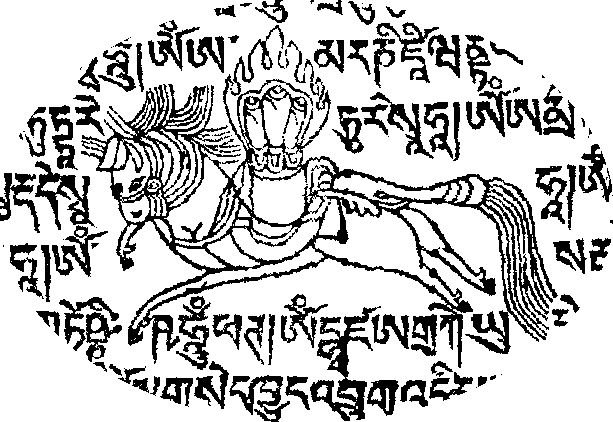
(We continue to listen to Dalai Lama as he continues to describe Tibetan holidays! )
" It was such a happy time! People sat and talked during the performances, so familiar were they with the songs and dances that they knew every incident by heart. Almost everyone brought a picnic and tea and chang and they would come and go as they pleased. Young women suckled babies at their breasts. Children ran to and fro-shrieking and laughing-stopping only for seconds to stare wide-eyed as a new performer, clad in wild and colourful costume, made his entrance. At this too, the expressions of the old men who sat alone and stony faced would brighten and for a moment the old women would cease their chatter. Then everything would carry on as before. And all the while, the sun bore steadily down through thin,exhilarating mountain air.
The only time you could be sure of everyone's complete attention was when satires were performed. Then the actors appeared dressed as monks and nuns, high officials and even as the state oracles to lampoon public figures.
Other important festivals during the year included the festival of Mahakala held on the eighth day of the third month. this was when summer officially began and on that day all members of the Government changed into summer dress. This was also the day when I shifted from the Potala to the Norbulingka. On the fifteenth day of the fifth month was Zamling Chisang, Universal Prayer Day, which marked the beginning of a weeklong holiday period when most of the population of Lhasa who were not either monks, nuns or members of the Government decamped in tents to the plains outside Lhasa for a series of picnics and other social amusements. Actually, I am fairly certain that some people who were not supposed to attend this did so, but in disguise. Then on the twenty-fifth day of the tenth month, which marked the death of Tsonkapa, the great reformer of Buddhism in Tibet and founder of the Gelugpa tradition, there was a special festival. It involved torchlight processions and the lighting of innumerable butter lamps throughout the land. This event also marked the day when winter formally began, officials changed into winter dress and I moved reluctantly back to the Potala. I longed to be old enough to follow the example of my predecessor who, having participated in this procession, used to return to the Norbulingka, which he much preferred.
There were also a number of purely secular events held at different times during the year, for example the horse fair, which was held during the first month. There was likewise a particular time of year, autumn, when nomads brought yaks to be sold to the slaughtermen. This was a very sad time for me. I could not bear to think of all those poor creatures going to their deaths. If ever I saw animals being taken behind the Norbulingka on their way to market, I always tried to buy them by sending someone out on my behalf. That way I was able to save their lives. Over the years I should imagine I must have rescued at least ten thousand animals, and probably many more. When I consider this, I realise that this extremely naughty child did do some good after all.
On the day before the opera festival of summer 1950, I was just coming out of the bathroom at the Norbulingka when I felt the earth beneath my feet begin to move. The tremors continued for several seconds. It was late evening and, as usual, I had been chatting to one of my attendants whilst I washed before going to bed. The facilities were then situated in a small outbuilding a few yards from my quarters so I was outside when this happened. At first, I thought we must have had another earthquake as Tibet is quite prone to seismological activity.
Sure enough, when I went back inside, I noticed that several pictures hanging on the wall were out of alignment. It reminded me of the time I was in my rooms on the seventh story of the Potala during a quake. Then I had been extremely scared. But, on this occasion, there was no real danger as the Norbulingka consists only of one-and two-storey buildings. However, just then, there was a terrific crash in the distance. I rushed outside once more, followed by several sweepers.
As we looked up into the sky, there was another crash and another and another and another. It was like an artillery barrage- which is what we now assumed to be the cause of both the tremors and the noise: a test of some sort being carried out by the Tibetan army. In all, there were thirty to forty explosions, each appearing to emanate from the north-east.
Next day we learned that , far from being a military test, it was indeed some sort of natural phenomenon. Some people even reported seeing a strange red glow in the skies in the direction from which the noise came. It gradually emerged that people had experienced it not only in the vicinity of Lhasa but throughout the length and breadth of Tibet: certainly in Chamdo, nearly 400 miles to the east, and in Sakya, 300 miles away to the south-west. I have even heard that it was observed in Calcutta. As the scale of this strange event began to sink in, people naturally began to say that this was more than a simple earthquake. It was an omen from the gods, a portent of terrible things to come."
( The Chinese invaded Tibet from this direction beautiful one; this was a warning from the nature spirits. I promise to add more tomorrow...)
 *( please click here to read of the day with me )
 * This is from the book Freedom in Exile The Autobiography of the Dalai Lama by Tenzin Gyatso, the fourteenth
Dalai Lama of Tibet.

 ( Please see my spinning for you!) ( Tahshi Deleh gentle one! Kehrahng kusu debo yinpeh? I worked in our studio on the boards for your loom. With us working together two as one it continues to go well! Then I worked on the area outside the shed for awhile then returned to our studio to work a bit more on your loom and our a land of Tibet. I'm going to put the pages on our infosite;I'll put this up for now so we can rest.
 And so, as always we'll continue two as one on to tomorrow
my one gentle beautiful patient swift dream bright
long dark mane in sunlight
so for now I bid goodnight...Simjah Nahngo!)