
Through My Eyes
Saturday December 25
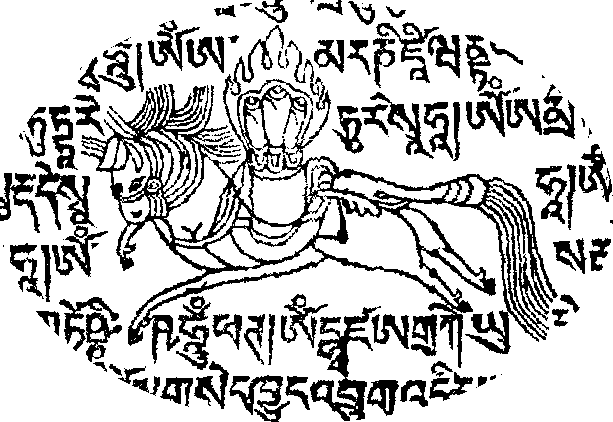
(We continue to listen to Dalai Lama as he tells of the arrival of supporters of the Tibetan cause! )
" In the end, the Federation of Malaya and the Republic of Ireland sponsored a draft resolution which was debated by the UN General Assembly during October. It passed in our favour in a vote split forty-five for and nine against, with twenty-six abstentions. India was one of the abstainers.
Also during this particular visit to the capital, I had meetings with a number of sympathetic Indian politicians, including Jaya Prakash Naryan who, true to his commitment back in 1957, had set up a Tibet Support Committee. There was now, he felt, a good chance of persuading the Government to change it's stance on Tibet. His enthusiasm was infectious and deeply moving, though instinctively I knew that Pandit Nehru would never change his mind. Another welcome development was news that the International Commission of Jurists, an independent organisation dedicated to upholding justice around the world, had recently published a report on the legal status of Tibet that vindicated our position entirely. The Commission, which had taken up our case early in the year, was now planning to conduct a full scale enquiry.
In October, after returning to Mussoorie, I recieved a welcome boost to morale when the Afro-Asian Committee met in Delhi. It devoted almost the whole of its business to discussing the Tibetan issue. The majority of its delegates were from countries that had themselves suffered from colonial oppression, so naturally they were well disposed towards Tibet. They saw us in the same position as they themselves had been before they won their independence. I recieved reports of their unanimous support with feelings of great joy and optimism and began to feel that something positive must surely come of all this. But alas, deep down it was clear to me that the Prime Minister was right. We Tibetans must not think in terms of a early return to our country. Instead we must concentrate on building a strong community in exile so that when the time eventually came, we would be able to resume our lives back home transformed by our experience.
The offers of land Nehru had mentioned seemed to hold the best prospect of allowing us to do this. Three thousand acres near to Mysore in southern India were immediately available if we wanted them, but , generous though this was, I was at first hesitant to accept. I had visited the area whilst on pilgrimage during my first visit to the country, and knew the area to be quiet and lightly populated. However, it is considerably hotter there than it is in the north and I felt that the conditions would likely be too harsh. Furthermore, with my administration located in Dharamsala, I feared the distance was too great.
On the other hand, given our present situation, I realised it was necessary to think in terms of settling semi-permanently in India. Only then would it be possible to begin an education programme and take steps to ensure the cultural continuity of the Tibetan people. In the end, I concluded that these considerations outweighed the geographical and psychological problems, and I gratefully accepted the land. A first batch of 666 settlers would leave in the New Year of 1960 to begin the work of making it habitable. On the basis of one acre per refugee, the eventual aim was to establish a community of 3,000.
Towards the end of 1959 came news of two organisations, the Central Relief Committee, headed by Acharya Kripalani, and the American Emergency Committee for Tibetan Refugees, that had been set up specifically to help us. These were later followed by other similarly dedicated agencies in other countries which, between them, provided invaluable assistance.
Meanwhile, I began to receive visits from a number of interesting people. One of these was the same Indian monk that I had met in Dromo when he was travelling with a relic of the Lord Buddha. I was delighted to see him again. He was very scholarly and had a particular interest in socio-economics. in the time since we had last met, he had expended much time and energy in trying to synthesise Marxist ideology with the spirituals of Buddhism. This interested me greatly. I was convinced that, because so much of Asia, from the Thai border up to Siberia, whose native faith was Buddhism, was now suffering terribly as a result of Marxism's hostility to religion, such work was vital.
Also at around this time, I received a visit from a left-leaning Sinhalese monk. At the end of his stay in Mussoorie, my new friend invited me to Sri Lanka. This was somewhere I very much wanted to go to, not the least because it would give me the opportunity to see the most important of all relics, the Buddha's tooth. However, some months later, when the time approached for me to make the journey, I received a forceful indication of how uncertain is the status of a refugee. The Sri Lankan Government sent a communication regretting that my visit would have to be indefinitely postponed as there had been 'unforeseen developments'. These turned out to have originated from Peking."
( China continuing to exert it's harmful effect. I promise to add more tomorrow...)
 *( please click here to read of the day with me )
 * This is from the book Freedom in Exile The Autobiography of the Dalai Lama by Tenzin Gyatso, the fourteenth
Dalai Lama of Tibet.

 ( Please see my spinning for you!) ( Tahshi Deleh gentle one! Kehrahng kusu debo yinpeh? I began the day in our studio spinning for you then worked a bit more on the printing block whcih with us working two as one together is going quite well. After that it was the usual festivities! We've a new video called the Heart of Tibet and one about the creation and use of labyrinths to work with energy just like the one at Perelandra! Then I wandered about for awhile taking pictures before heading up gang rinpoche ngah-tso gi to check on our trees and native plants. After that I rested by your Medlar tree as usual before heading to our studio. Two as one we helped Mom and Kathy to put up the new birdfeeder before working on the Grove pages then our a land of Tibet. Our commitment to each other is a great source of strength and hope to me beautiful one. I'm going to put the pages up on our infosite;I'll put this up for now so we can rest.
 And so, as always we'll continue two as one on to tomorrow
my one gentle beautiful patient swift dream bright
long dark mane in sunlight
so for now I bid goodnight...Simjah Nahngo!)