
Through My Eyes
Saturday January 15
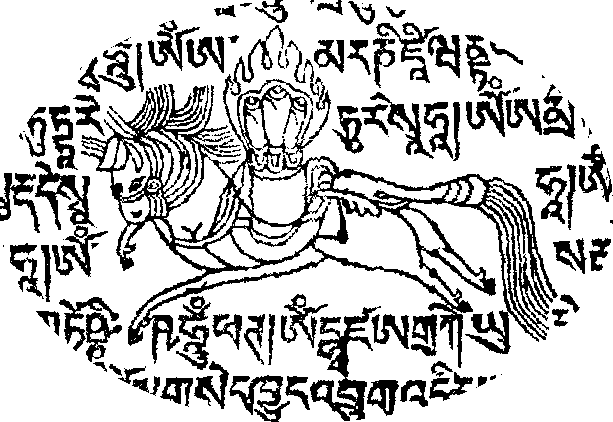
(We continue to listen to Dalai Lama as he tells of Dharamsala! )
" It was quite late when we arrived so I was not able to see much, but the following morning, when I woke, the first thing I heard was the distinctive call of a bird which I later discovered is peculiar to this place. 'Kara-chok, Kara-chok,' it seemed to say. I looked out of the window to see what it was, but could not find it. Instead, my eyes were greeted by a view of the magnificent mountains.
On the whole, our experience at Dharamsala has been quite happy, although I note that Kundeling rediscovered his taste for Mussoorie milk and retired back there some time ago. The only real drawback of the Dharamsala region is its rainfall, which is the second highest in the Indian subcontinent. At first there were less than a hundred Tibetans all told. But today the refugee population has grown to more than five thousand. Only once or twice has there been any serious thought of moving. The last time was a few years ago when a severe earthquake caused some damage to several buildings. People began to say that it was too dangerous to remain. We did not leave, however, mainly because whilst there is quite often seismic activity in the area, it is normally only slight. The last serious disturbance occurred in 1905, during the time that the British used the place as a summer retreat. On that occasion, the spire of their parish church was knocked down. So it seems reasonable to assume that large-scale tremors are very infrequent. Besides which, for practical reasons, it would be very difficult to move.
As at Birla House, I shared my new home with my mother-and also a couple of Lhasa Apso dogs which had recently been presented to me. These animals were a continual source of amusement to everyone. They both had very distinctive characters. The large of the two was called Sangye. I often thought that he must have been a monk in his previous life, perhaps one of those who died of starvation in Tibet, as many did. I say this because on the one hand he showed no interest in the opposite sex, but on the other, he was most enthusiastic about food: even when he must have been completely full, he could always find room for more. Also, he was extremely loyal to me.
Tashi, the other, was very different. Despite being smaller, he was much the heavier of the two. He was given to me by Tenzin Norgay, the Everest mountaineer, so that may have had something to do with it. I well remember a time when he got ill and had to be given injections. After the first of these, he became very frightened. So on succeeding occasions when the vet came, he had to caught up by two people and held down whilst the drugs were administered. Meanwhile, Tashi would growl and snarl at his persecutor who, when he had completed his work, had quickly to leave the house. Only then was it safe to let the little dog go, whereupon he would go racing off, sniffing all over the house in search of the poor man. But if he seemed rather ferocious, his bark was much worse than his bite: his jaw overlapped in such a way that he could not actually sink his teeth into anything.
When I moved to Dharamsala, I went with an Indian Government liaison officer, Mr. Nair, and a number of Indian army bodyguards. I had an excellent relationship with Mr. Nair, who volunteered to teach me English. Realising its importance, I had already arranged for Tenzin Choegyal to be sent to North Point, an English school in Darjeeling, and had started taking language lessons while at Mussoorie. Very generously, the Indian Government had provided someone to give me regular coaching, perhaps two or three times a week. But I was not at that time a very willing pupil and quickly found excuses to avoid them. So far I had made little progress. However, I enjoyed working with my new liaison officer and progressed well under his tuition, though I could not get enthusiastic about the mass of writing he gave me to do. I was sorry when he was posted elsewhere after two years.
From then on, my instruction in English was much less formal. Various other people helped me, including some Tibetans, but I doubt whether my command of the language is much better now than it was twenty-five years ago. I am always painfully reminded of this when I go abroad. I am often embarrassed at the terrible mistakes I make and regret that I did not work harder when I had the opportunity.
In addition to learning English during those first years of living in Dharamsala, I also rededicated myself to religious study. I began by reviewing a number of Tibetan texts I had first looked at as a teenager. At the same time, I took teachings from some of the spiritual masters of different traditions that had come into exile. And although the realisation of Bodhichitta (the aspiration to achieve Buddhahood for the benefit of all sentient beings) still seemed a long way off, I found that now there was no compulsion to work, the idea of it was not as unpleasant and I began to get a lot done. Unfortunately, lack of time quickly became a major obstacle to advancement in this sphere. But I can say that , insofar as I have achieved anything spiritually, it is out of all proportion to the amount of effort I have managed to get in."
(There were some very advanced masters that went into exile! I promise to add more tomorrow...)
 *( please click here to read of the day with me )
 * This is from the book Freedom in Exile The Autobiography of the Dalai Lama by Tenzin Gyatso, the fourteenth
Dalai Lama of Tibet.

 ( Please see my spinning for you!) ( Tahshi Deleh gentle one! Kehrahng kusu debo yinpeh? I began the day in our studio spinning for you then headed out to wander about near the studio taking pictures. The water has receded leaving thin panes of ice in lots of wondrous patterns in the field! After that I returned to our studio to work on our a land of Tibet. Two as one we've fixed a few more mistakes on the pages. I'm going to put the pages up on our infosite;I'll put this up for now so we can rest.
 And so, as always we'll continue two as one on to tomorrow
my one gentle beautiful patient swift dream bright
long dark mane in sunlight
so for now I bid goodnight...Simjah Nahngo!)