
Through My Eyes
Saturday January 29
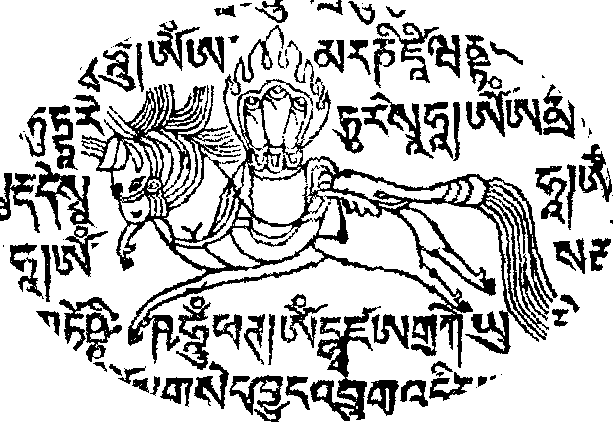
(We continue to listen to Dalai Lama as he tells of difficulties in exile.)
" To begin with, these new arrangements were not very satisfactory. Because the changes were radical to Tibetans, some people even suggested that the Government in Dharamsala was practicising true Communism! Three decades later, we are still faced with many problems, but things are changing and improving all the time. Certainly we are far ahead of our brothers and sisters in China, who could learn a great deal from us. At the time of writing, the Tibetan Government in Exile is in process of implementing new measures to promote democracy further.
Some of the older officials who had come into exile found these changes hard to accept at first. But, on the whole, they saw the need for reform of our system and worked hard and enthusiastically to achieve it. I shall always think fondly of them. In the early years, although I was able to live in some degree of comfort, the same was by no means true for the majority of government officials. Many of them, even quite elderly men, were compelled to live under very poor conditions - some taking shelter in cowsheds for example. But this they did cheerfully and without complaint, even though they had often lived extremely well throughout their lives in Tibet. And even if some of them disagreed in their hearts with the direction in which I was heading, due to their conservativism, each and every one contributed something during those dark days. They faced the difficulties we shared with great joy and determination and did all they could to help rebuild the shattered lives of our people, entirely without thought of personal gain. Their salary in those days was not above 75 rupees, or 3 pounds, a month, even thought they could have done much better for themselves elsewhere, thanks to their education.
None of which is to say that the business of administration at that time was easy. Naturally, there were some personal differences between people and a fair amount of petty squabbling. That is only human nature. But overall, everyone expended their energies enthusiastically and unselfishly for the good of others.
My other main preoccupation right from the start was the preservation and continuation of our religion. Without it, I knew that the well-spring of our culture would dry up. Initially, the Government of India agreed to provide for a scholastic community of 300 monks to be established at the old prisoner-of-war camp at Buxa Duar, near the Bhutanese border. But, by explaining that Buddhism depends on a high standard of scholarship, we managed eventually to persuade them to increase the commitment to funding for 1,500 of all traditions. This figure represented the youngest and most able of the 6,000-odd monks who had escaped into exile, and as many experienced teachers as had survived.
Unfortunately, conditions at Buxa Duar remained very bad. The climate there was especially hot and humid and disease was rampant. These problems were exacerbated by the fact that food rations had to be sent in from far away. When they arrived, they were often in an extremely bad state. Within months, several hundred of these scholar monks had developed tuberculosis. Nevertheless, they worked and studied hard until they could be moved. To my sorrow, I was unable to visit the site but, meanwhile, I tried to sustain them with letters and taped messages. Evidently, this paid off to some degree for, although the camp never overcame it's terrible problems, the survivors became the nucleus of a vigorous monastic community.
Of course, one of the greatest difficulties we faced during those early years was lack of money. This was not a problem so far as our educational and resettlement programmes were concerned, thanks to the enormous generosity of the Indian Government and the various voluntary agencies overseas, which funded many projects. But I did not feel that it was appropriate to ask for assistance with things like the Administration. The small amount of revenue raised by the imposition of a voluntary freedom tax of 2 rupees per person per month, combined with a similarly voluntary monthly income tax of two percent for salaried workers, did not go far. However, we had a lifeline in the form of treasure, which Kenrap Tenzin had deposited in Sikkim with such foresight back in 1950. It was still there.
At first, I had it in mind to sell the treasure directly to the Indian Government, a plan proposed by Nehru himself. But my advisors were adamant that the treasure should be sold on the open market. They were certain we could get more for it that way. So it was finally disposed of in Calcutta, where it fetched what seemed to me an enormous sum, equivalent then to $8 million.
A number of enterprises were invested in with this money. There was a plant to manufacture iron pipes and a business connected with a paper mill, amongst other supposedly guaranteed money-spinning projects. Unfortunately, it was not long before each of these attempts to make our precious capital work for us failed. Sadly, we were not well served by a number of people who were ostensibly helping us. It seems they were more interested in helping themselves, and we lost the majority of the funds. The vision of the Chikyah Kenpo turned out to have been largely wasted."
( Terrible that a people in such extremity should have been stolen from. I promise to add more tomorrow...)
 *( please click here to read of the day with me )
 * This is from the book Freedom in Exile The Autobiography of the Dalai Lama by Tenzin Gyatso, the fourteenth
Dalai Lama of Tibet.

 ( Please see my spinning for you!) ( Tahshi Deleh gentle one! Kehrahng kusu debo yinpeh? I began the day in our studio spinning for you then worked a bit more on the printing block which with us working two as one pulling strongly and patiently together is going quite well! After that I wandered about for awhile taking pictures before heading up gang rinpoche ngah-tso gi to check the trees and native plants. The stream sounds quite wondrous as it flows beneath the ice; I'll bring us a recording of it soon! Then I rested by your Medlar tree as usual before returning to our studio to work on our a land of Tibet. The snow is easier to walk on now although it's still a bit slick in spots. I hope you liked the picture of me from our sacred place. I carved the staff some time ago. It looks very shamanic! Two as one we've fixed a few more mistakes on the pages as usual. I'm going to put the pages up on our infosite; I'll put this up a bit early so we can rest.
 And so, as always we'll continue two as one on to tomorrow
my one gentle beautiful patient swift dream bright
long dark mane in sunlight
so for now I bid goodnight...Simjah Nahngo!)