
Through My Eyes
Saturday February 21
(We continue to listen to the Dalai Lama as he describes the Chinese government propaganda. )
" Ngabo suggested that we had no alternative but to negotiate. If it was agreeable to the Tibetan Government, and if we would send some assistants, he proposed to go in person to try to open a dialogue with the Chinese in Peking. I contacted Lobsang Tashi and Lukhangwa in Lhasa to find out their opinion. They replied that they felt such negotiations should take place in Lhasa, but since the situation was desperate, they would have to agree to Peking as the venue.
Because he had shown no hesitation in offering himself for the task, I concluded that Ngabo, whom I knew to be a very decisive administrator, should go to the Chinese capital. Accordingly, I sent two officials from Dromo and two from Lhasa to accompany him. I hoped that he could make it clear to the Chinese leadership that Tibet did not require 'liberation', just continued peaceful relations with our great neighbour.
Meanwhile, spring came, and with it the outpourings of Nature. The hills were soon splashed with wild flowers; the grass took on an altogether new and richer shade of green; and the air became scented with fresh and surprising smells-of jasmine,honeysuckle and lavender. From my rooms in the monastery, I could look down towards the river where farmers came to graze their sheep, yaks and dzomos. And I could watch, enviously, the groups of picnickers that came almost daily to build a little fire and cook down by the water's edge. I was so enchanted with all that I saw that I felt brave enough to ask Ling Rinpoche for some time off. He must have felt the same way as, to my surprise, he granted me a holiday. I could not remember being happier as I spent several days roaming around the area. On one of my excursions I visited a Bon monastery. My only sadness was that I knew that troubled days lay ahead. It could not be long before we heard form Ngabo in Peking. I half expected bad news, but nothing could have prepared me for the shock when it came.
At the monastery I had an old Bush radio receiver which ran off a six-volt battery. Every evening, I would listen to the Tibetan language broadcasts of Radio Peking. Sometimes I did so with one or other official, but often I listened alone. The majority of the broadcasts were taken up with propaganda about the 'Glorious Motherland', but I must say that I was very impressed with much of what I heard. There was constant talk of industrial progress and of the equality of all China's citizens. This seemed like the perfect combination of material and spiritual progress. However, one evening, as I sat alone, there was a very different sort of programme. A harsh, crackling voice announced that a Seventeen-Point 'Agreement' for the Peaceful Liberation of Tibet had that day been signed by representatives of the Government of the People's Republic of China and what they called the 'Local Government ' of Tibet.
I could not believe my ears. I wanted to rush out and call everybody in, but I sat transfixed. The speaker described how ' over the last hundred years or more' aggressive imperialist forces had penetrated into Tibet and 'carried out all kinds of deceptions and provocations.' It added that 'under such conditions, the Tibetan nationality and people were plunged into the depths of enslavement and suffering'. I felt physically ill as I listened to this unbelievable mixture of lies and fanciful cliches.
But there was worse to come. Clause One of the 'Agreement' stated that 'The Tibetan people shall unite and drive out imperialist aggressive forces from Tibet. The Tibetan people shall return to the big family of the Motherland-the People's Republic of China.' What could it mean? The last foreign army to have been stations on Tibetan soil was the Manchu army in 1912. As far as I was aware ( and now know), there was no more than a handful of Europeans in Tibet at that time. And the idea of Tibet 'returning to the Motherland' was shameless invention. Tibet had never been a part of China. In fact, as I have mentioned already, Tibet has ancient claims to large parts of China. On top of which, our respective peoples are ethnically and racially distinct. We do not speak the same language, nor is our script anything like the Chinese script. As the International Commission of Jurist stated subsequently in their report:
Tibet's position on the expulsion of the Chinese in 1912 can fairly be described as one of de facto independence...it is therefore submitted that the events of 1911-12 mark the re-emergence of Tibet as a fully sovereign state, independent in fact and in law of Chinese control."
(What an awful shock that must have been. I promise to add more tomorrow...)
 *( please click here to read of the day with me )
 * This is from the book Freedom in Exile The Autobiography of the Dalai Lama by Tenzin Gyatso, the fourteenth
Dalai Lama of Tibet.

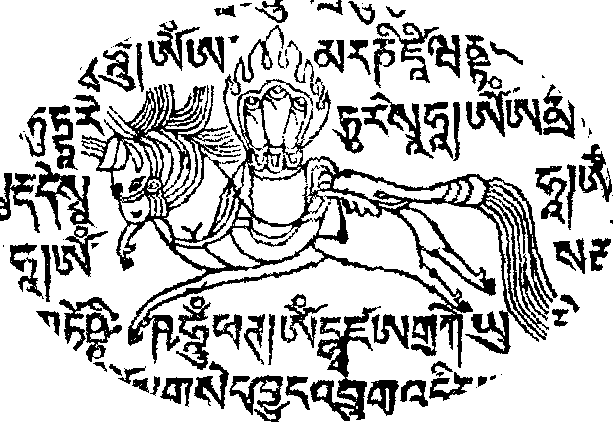
 ( Please see my spinning for you!) ( Tahshi Deleh gentle one! Kehrahng kusu debo yinpeh? I thought you might like that picture; it has a mysterious quality about it. I actually spent the entire day in our studio working on the design for your loom. I'm trying to set up for cloth the full width of a prayer flag. With us working two as one, it's going quite well as usual! We've figured out how to set things up fairly easily on a small frame on the bench. I'm going to put the pages on our infosite and work a bit on our a land of Tibet;I'll put this up so we can rest.
 And so, as always we'll continue two as one on to tomorrow
my one gentle beautiful patient swift dream bright
long dark mane in sunlight
so for now I bid goodnight...Simjah Nahngo!)