
Through My Eyes
Saturday March 27
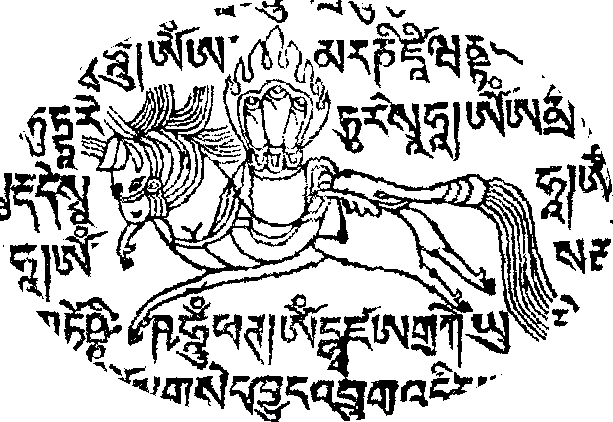
(We continue to listen to the Dalai Lama as he describes the unrest in Lhasa.)
" I now see the first five or six weeks after my return to Lhasa from Dromo as a honeymoon period. It ended abruptly on 26 October 1951, when 3,000 troops of the Chinese 18th Route Army entered Lhasa. These were men who belonged to the division that had overcome our forces in Chamdo the previous year. With them came Generals Tan Kuan-sen and Chiang Kuo-hua, who, when they came for an audience, were accompanied by a Tibetan in national costume and fur hat. As they entered the room, this man made three formal prostrations. I thought this rather strange as he was evidently a member of the Chinese delegation. It turned out that he was the interpreter, and a loyal supporter of the Communists. When I later asked why he was not wearing the same Mao suits as his companions, he replied good-naturedly that I must not make the mistake of thinking that the Revolution was a revolution in dress; it was a revolution of ideas.
Also at around this time, my brother Gyalo Thondup arrived back in Lhasa. He did not stay long, but whilst in the city he met with the Chinese leadership several times. He then announced his intention to travel south, where my family had an estate given to them by the Government at the time of my enthronement. This visit to oversee the property was only a ruse however, and I soon learned afterwards that he had disappeared. It turned out that he had slipped over the border into Assam, then known as NEFA, the North-Eastern Frontier Area. He intended to do what he could in the way of organising foreign support, but had not told me of his plans because he feared , on account of my age, that I might let his secret out in an unguarded moment.
Within a short time, a further large detachment of the PLA reached Lhasa. I well remember their arrival. Because of the altitude, sound carries over great distances in Tibet and, as a result, I heard the slow, insistent thud of martial drums in my room at the Potala long before I saw any soldiers. I rushed out on to the roof with my telescope, where I watched them approach in a long, snaking column enveloped in clouds of dust. When they reached the city walls, there was a flourish of red banners and posters depicting chairman Mao and his deputy, Chu Te. Then came a fanfare of trumpets and tubas. It was all most impressive. So were the troops, who looked positively demonic.
Later, after I had got over a feeling of great uneasiness at the sight of all their red flags (this is after all, Nature's colour for danger), I noticed that the soldiers were actually in a very poor state: their uniforms were ragged and they all looked undernourished . It was this together with the grime on their faces from the eternal dust of the Tibetan plains, that gave them their frightening appearance.
Throughout the winter of 1951-2 , I continued with my studies much as usual, though more diligently. It was during this period that I began Lam Rim meditations. These relate to a text which expounds a stage-by-stage path to enlightenment through mental training. Since around the age of eight, I had begun, in tandem with my monastic education, to receive Tantric teachings such as these. In addition to scriptures, they consisted of secret, oral transmissions handed down by initiates. As the months went by, I began to notice some progress in myself as I laid down the foundations of my own, very slight, spiritual development.
Whilst I was making my annual retreat at this time, I heard that Tathag Rinpoche had passed away . I very much wanted to attend his cremation, but could not, so I offered special prayers for him.
My other preoccupation that winter was to do all I could to encourage my Prime Ministers and Kashag. I reminded them of the Buddhist doctrine of Impermanence and pointed out that the present situation could not last for ever, even if it did last for our lifetimes. But privately, I followed events with increasing anxiety. The only happy occasion to look forward to was a visit by the Panchen Lama, who was due to reach Lhasa shortly.
Meanwhile, following the arrival of the last consignment of 20,000 troops, a serious food shortage was developing. The population of Lhasa had almost doubled in a matter of weeks, and it could not be long before our meagre resources gave out. At first the Chinese kept more or less to the provisions of the Seventeen-Point 'Agreement' , which stated that the PLA should 'be fair in all buying and selling and shall not arbitrarily take a needle or thread from the people'. They paid for the grain the Government gave them and reimbursed the owners of houses that were requisitioned to quarter their officers.
However, this system of renumeration soon broke down. Money ceased to change hands and the Chinese began to demand food and lodging as of right. Very quickly, a crisis developed. Inflation took off. This was something that had never been experienced before and my people did not understand how the price of grain could double overnight. They were outraged and their previously passive hatred of the invaders turned abruptly to active derision. In the traditional way to drive out evil, they began to clap and spit whenever they saw groups of Chinese soldiers. Children began to throw rocks and stones, and even monks would wind the loose folds of their robes into a bunch and use it for whipping any soldiers that came near. "
( Given the difficulties of life in Tibet an occupying army would have created tremendous hardship. I promise to add more tomorrow...)
 *( please click here to read of the day with me )
 * This is from the book Freedom in Exile The Autobiography of the Dalai Lama by Tenzin Gyatso, the fourteenth
Dalai Lama of Tibet.

 ( Please see my spinning for you!) ( Tahshi Deleh gentle one! Kehrahng kusu debo yinpeh? I began the day bringing tree food to the trees of the Grove. Then I worked to bring more to the trees and plants around our studio then Mom's garden. There's more to be done of course but two as one we continue to progress and have put out over 20,000 pounds! Then I worked a bit on the design of your loom and our a land of Tibet. I'm going to put the pages on our infosite;I'll put this up so we can rest.
 And so, as always we'll continue two as one on to tomorrow
my one gentle beautiful patient swift dream bright
long dark mane in sunlight
so for now I bid goodnight...Simjah Nahngo!)