
Through My Eyes
Saturday February 26
(We continue to listen to Dalai Lama as he tells of changing fortunes in India. )
" I remained in contact with Pandit Nehru right up to his death in 1964. He himself continued to take a close interest in the plight of the Tibetan refugees, especially the children whose education he always held to be of the greatest importance. Many people say that the Sino-Indian War broke his spirit. I think they may be right. I saw him for the last time in May of that year. As I entered his room, I sensed that he was in a state of deep mental shock. He had just suffered a stroke and was very weak and haggard-looking, propped up in an armchair with pillows under each arm. As well as obvious sings of acute physical discomfort, I also noticed indications of intense mental strain in him. Our meeting was short and I left with a heavy heart.
Later that same day he left to go to Dehra Dun, and I went to bid him farewell at the airport. When I got there, I happened to see Indira Gandhi, his daughter, whom I had come to know well over the years since I first met her when she accompanied her father to Peking in 1954. ( I had first been under the impression that she was his wife). I told her how sorry I was to find her father in such poor health. I went on to say that I feared I had seen him for the last time.
As it turned out I was right, for within less than a week he was dead. Unfortunately, I was unable to attend his cremation. Instead, I participated in the scattering of his ashes at the confluence of the three rivers in Allahabad. This was a great honour for me, as it made me feel close to his family. One of it's members that I saw there was Indira. Sometime after the ceremony, she came up to me and, looking straight into my eyes said, 'you knew.'
Tsering Dolma also died in 1964. Her work was taken over by Jetsun Pema, our younger sister, who has shown similar courage and determination. Today, the nursery thrives as part of the Tibetan Children's Village (TCV) in Dharamsala.
The TCV, which has many branches throughout the settlements, today houses and educates more than six thousand children in all, around fifteen hundred of them in Dharamsala. Although most of the initial funding was by the Indian Government, much of the expense is now met by the charity SOS International. Thirty years on, it is pleasing to see the results of our efforts in the field of education. Presently, more than two thousand refugee children have graduated form schools of higher education- most of them in India, but a growing number in the West.
In those early days, these schools were nothing more than dilapidated buildings where Indian teachers taught very diverse groups of children. Now, we have a healthy number of qualified Tibetan staff. But still there are considerable numbers of Indian educators involved. To these men and women, and their predecessors, I wish to offer my deepest thanks. I cannot adequately express the gratitude I feel for the many who have so freely devoted much of their lives to the service of my people, often in very poor conditions and in remote areas.
On the negative side, it is unfortunately the case that many children do not finish their education, especially girls. This is sometimes due to their own disinclination, sometimes to their parents shortsightedness. Whenever I have the opportunity, and it is appropriate, I tell parents that they have a great responsibility not to use their children's small hands for their own short-term benefit. Otherwise, there is a danger of producing semi-educated children, who see the colourful opportunities of life but, because of their lack of education, are not equipped to grasp them. This can result in dissatisfaction and even greed.
The man who succeeded Pandit Nehru as Prime Minister was Lal Bahadur Shastri. Despite his being in power for less than three years. I met him quite a number of times and grew to respect him very much. Like Nehru before him, Shastri was a great friend of the Tibetan refugees. Even more than Nehru, however, he was also a political ally.
In autumn 1965, Tibet was discussed at the United Nations once more, thanks to a draft resolution submitted by Thailand, the Philippines, Malta, Ireland, Malaysia, Nicaragua and El Salvador. On this occasion India, at Shastri's insistence, voted in favour of Tibet. During his tenure of office, it began to look as if the new Indian Government might even recognise the Tibetan Government in
Exile. But sadly, the Prime Minister, did not live long. In the meantime, India went to war once more, this time with Pakistan."
( More terrible sadness in India. I promise to add more tomorrow...)
 *( please click here to read of the day with me )
 * This is from the book Freedom in Exile The Autobiography of the Dalai Lama by Tenzin Gyatso, the fourteenth
Dalai Lama of Tibet.

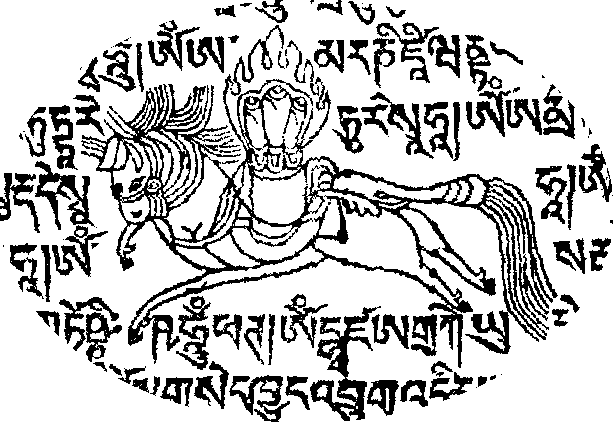
 ( Please see my spinning for you!) ( Tahshi Deleh gentle one! Kehrahng kusu debo yinpeh? I began the day in our studio spinning for you then worked a bit more on the printing block which with we two working as one pulling strongly and patiently together is going quite well! After that I headed up gang rinpoche ngah tso gi to continue our work in the Grove. It wasn't our warm and bright future day but it was beautiful up there with the Tenger moving great billowing clouds across the sky! After that I rested by your Medlar tree as usual before heading to our studio to begin printing with our carved printing block. It went quite well! I've brought us the pictures to look over together. After that I worked a bit on the Grove pages then on our a land of Tibet. Two as one we've fixed a few more mistakes on the pages as usual. I'm going to put the pages up on our infosite;I'll put this up for now so we can rest.
 And so, as always we'll continue two as one on to tomorrow
my one gentle beautiful patient swift dream bright
long dark mane in sunlight
so for now I bid goodnight...Simjah Nahngo!)