
Through My Eyes
Saturday March 12
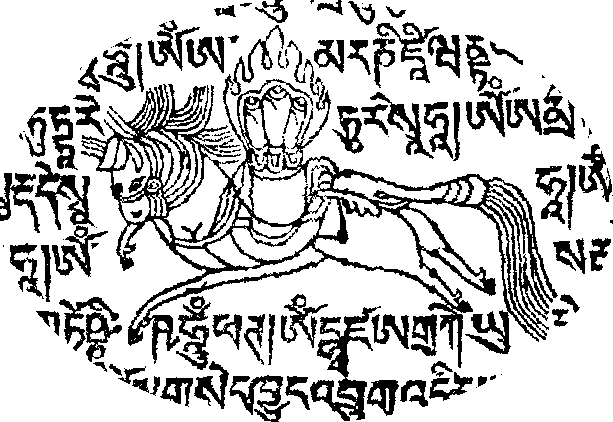
(We continue to listen to the Dalai Lama as he tells of his becoming a vegetarian! )
" To check my resolve, I had the food sent to me. When it arrived, I looked at it very carefully. The chicken had been cooked in the English style, with onions and gravy, it smelled delicious. But I had no difficulty refusing it. From that moment on, I adhered minutely to the vegetarian rule and, in addition to abstaining from meat, ate neither fish nor eggs.
This new regime suited me well and I was very content; I felt sense of fulfillment from a strict interpretation of a rule. Back in 1954, in Peking, I had discussed the subject of vegetarianism with Chou En-lai and another politician at a banquet. This other man claimed to be vegetarian, yet he was eating eggs. I questioned this and argued that because chickens come from eggs, eggs could not be considered to be vegetarian food. We disagreed quite strongly - at least until Chou brought the discussion to a diplomatic close.
The war with Pakistan ended on 10 January 1966. But with this happy event came bad news, the death of Prime Minister Shastri in Tashkent, where he had gone to negotiate a settlement with the Pakistani President, Ayub Khan. He passed away within a few hours of signing the peace treaty.
Lal Bahadur Shastri has left a powerful impression on my memory for, although he was a small, rather weak and ineffectual looking man, he had a powerful mind and spirit. Despite his frail appearance, he was an outstanding leader. Unlike so many people who hold positions of great responsibility, he was bold and decisive: he did not allow events to carry him along, but did his best to direct them.
Shortly after, I was invited to attend the cremation, which I did on my way back home from Trivandrum. It was a sorrowful affair, particularly as it was the first time in my life that I had seen a dead body from close up- even though as a Buddhist I visualise death every day. I remember looking at his inert form lying on top of the funeral pyre and recalling all his mannerisms and the little bits of personal information he had shared with me. He himself was a strict vegetarian, he had told me, because as a young schoolboy he had once chased a pigeon round and round until it died of exhaustion. he was so horrified at what he had done that he vowed never to eat another living creature. So not only had Tibet lost a true and mighty friend, not only had India lost one of her finest politicians, not only had the world lost an enlightened leader, but mankind had lost a genuinely compassionate spirit.
After paying my final respects to the late Prime Minister, I returned to Dharamsala, but not before visiting some of the hospitals in Delhi containing casualties from the war. Most of those that I saw were officers. Many were in great pain and enduring terrible hardship. As I walked between the rows of beds, amongst sobbing family members of the wounded, I thought to myself that this was the only real result of war: tremendous human suffering. Anything else that might arise from conflict could be brought about by peaceful means. It was small consolation to realise that the people in this hospital were being well looked after: many of those who had been caught up in the struggle would not have the benefit of such good facilities.
A fortnight later, Indira Gandhi was sworn in as Prime Minister of India. Because I had seen her practically every time I saw her father, I already felt quite close to her. I have reason to believe that she felt quite close to me too. More than once she took me into her confidence about people and things that were causing her trouble. And for my part, I considered that I knew here well enough to be able to remind her, on one occasion towards the end of here first administration, that it is vital for a leader to keep in touch with the common people.
I myself had learned at an early age that anyone who wishes to lead must remain close to the common people. Otherwise, it is all too easy to be misled by advisors and officials and others around you who, for reasons of their own, might wish to prevent you from seeing things clearly.
As with each of India's Prime Ministers, I owe a great debt of gratitude to Indira Gandhi for her warm support of the Tibetan refugees. From its inception, she was a member of the Tibetan Homes Foundation based in Mussoorie and was particularly helpful in the field of education. She had her father's vision when it came to the importance of schooling. And although much strong language was used to denounce here after the Emergency, with some people even calling her a dictator, I note that she relinquished power quite gracefully when the electorate delivered its verdict in March 1977. To me that was a wonderful example of democracy in action: though there was much conflict both within Parliament and without, when the moment came for here to leave, she did so without a fuss. I remember thinking the same about President Nixon. So often a change of leadership is taken as a cue for blood-letting. It is a sign of a truly civilised country when parliamentary procedure triumphs over personal interest.
The People's Republic of China presented a very different picture of domestic politics at this time. From the mid 1960s until Mao's death in 1976, the country, together with its colonies, endured a series of bloody and violent upheavals. Many years passed before a true picture of the so-called Cultural Revolution began to emerge."
( The terrible Cultural Revolution of China begins. I promise to add more tomorrow...)
 *( please click here to read of the day with me )
 * This is from the book Freedom in Exile The Autobiography of the Dalai Lama by Tenzin Gyatso, the fourteenth
Dalai Lama of Tibet.


 ( Please see my spinning for you!) ( Tahshi Deleh gentle one! Kehrahng kusu debo yinpeh? I began the day in our studio spinning for you then continued work on the printing block which with we two working as one pulling strongly and patiently together is going quite well! We've completed the drawing of the design on the block and can begin carving soon! After that I headed outside to continue pruning the trees and native plants near the studio. I used a big aluminum ladder that Mom bought that allows me to work almost 20 feet up! After that I cleared around one of the pear trees where an elm had fallen. It broke a few branches but didn't harm the tree. It was a lot of work to clear things up though! We've just about completed the pruning in any case. After that I returned to our studio to work on our a land of Tibet. Two as one we've fixed a few more mistakes on the pages as usual. I'm going to put the pages up on our infosite; I'll put this up a bit early so we can rest.
 And so, as always we'll continue two as one on to tomorrow
my one gentle beautiful patient swift dream bright
long dark mane in sunlight
so for now I bid goodnight...Simjah Nahngo!)