
Through My Eyes
Saturday July 10
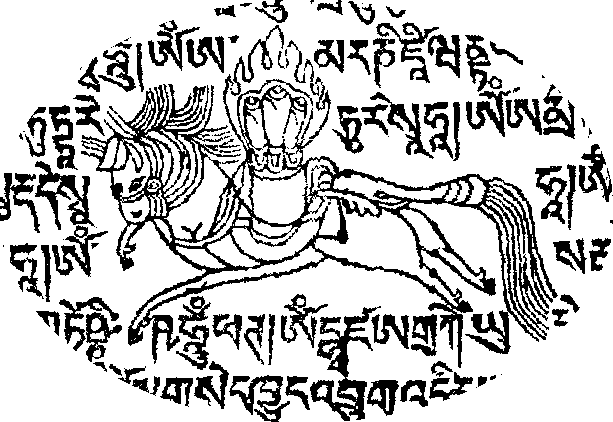
(We continue to listen to the Dalai Lama as he tells of his return to Lhasa!)
" When I arrived back in Lhasa in June 1955, I was greeted as usual by many thousands of people. My long absence had caused much sorrow amongst Tibetans and it was a relief that they now had the Dalai Lama back in their midst. It was a relief to me as well. Evidently, the Chinese were behaving with more restraint here than in eastern Tibet. On the return journey from China I had received, in addition to many ordinary people, numerous deputations from local chieftains begging that I ask our new masters to change their policies in those rural areas. They saw that the Chinese directly threatened the Tibetan way of life and were very afraid.
In the city itself, I found things were relatively normal, except that there were now many cars and trucks bringing noise and pollution to the city for the first time in history. The food shortages had eased and active displays of anger had given way to resentment mixed with passive resistance. Now that I was back, there was even a resurgence of optimism. For my part, I felt that my status amongst the local Chinese authorities must be enhanced by Mao's public show of confidence in me and I remained cautiously optimistic for the future.
Yet I was conscious that outside Tibet the world had turned its back on us. Worse, India, our nearest neighbor and spiritual mentor, had tacitly accepted Peking's claims to Tibet. In April 1954, Nehru had signed a new Sino-Indian treaty which included a memorandum known as Panch Sheel, whereby it was agreed that India and China would under no circumstances interfere with one another's 'internal' affairs. According to this treaty, Tibet was a part of China.
The summer of 1955 was undoubtedly the best we were to experience during the decade of uneasy coexistence between the Chinese authorities and my own Tibetan administration. But summer in Tibet is a short season and it was not many weeks before disturbing news began to reach my ears about the activities of the Chinese authorities in Kham and Amdo. Far from leaving the people be, they had begun to press ahead unilaterally with all kinds of 'reform'. New taxes were imposed on houses,land and cattle,and, to add insult to injury, the contents of monasteries were also assessed for tax. Large estates were confiscated and the land redistributed by the local Chinese cadres in accordance with their own political ideology. Landowners were publicly arraigned and punished for 'crimes against the people'; to my horror, some were even put to death. Simultaneously , the Chinese authorities began to round up the many thousands of nomad farmers who roamed these fertile regions. To our new masters, nomadism was repugnant as it smacked of barbarism. (In fact, mantze, a common Chinese word for 'Tibetan', literally mean 'barbarian'.)
Also disturbing was the news that the work of the monasteries was being grossly interfered with and the local population had begun to be indoctrinated against religion. Monks and nuns were subject to severe harassment and publicly humiliated. For example, they were forced to join in extermination programmes of insects, rats, birds and all types of vermin, even though the Chinese authorities knew that taking any form of life is contrary to Buddhist teaching. If they refused, they were beaten. Meanwhile, the Chinese in Lhasa carried on as if nothing were amiss. By not interfering with religion here in the capital, they were clearly hoping that I would be lulled into a false sense of security whilst they did as they pleased elsewhere.
Toward the end of 1955, preparations were put in hand for the inauguration of the Preparatory Committee for the Autonomous Region of Tibet (PCART), Mao's alternative to rule by military commission. But as autumn progressed to winter, the news from the east became worse. The Khampas, who were not used to outside interference, did not take kindly to Chinese methods: of all their possessions the one they valued above all others was their personal weapon. So when the local cadres began to confiscate these, the Khampas reacted with violence. Throughout the winter months the situation deteriorated rapidly. As it did so, refugees from Chinese oppression began to arrive in Lhasa, bringing with them horrifying stories of brutality and degradation. The Chinese dealt viciously with Khampa resistance: not only were public beatings and executions carried out but often these were done by the victims own child. Public self- criticism was also introduced. This is a method especially favoured by the Chinese Communists. The 'offender' is trussed up with a rope in such a way that the shoulders are dislocated. Then, when the person is utterly helpless and crying out in pain, members of the public- including women and children- are called forward to inflict further injury. Apparently, the Chinese felt that this was all it took to make people change their minds, and that it aided the process of political re-education.
At the beginning of 1956, during Losar, I had a very interesting encounter with the Nechung oracle, who announced that the 'light of the Wish-Fulfilling Jewel [one of the names by which the Dalai Lama is known to Tibetans] will shine in the West'. I took this to indicate that I would travel that year to India, though I now see that the prophecy had a deeper implication."
( The unresponsiveness of India's prime minister to the Dalai Lama at Peking is certainly explained by the betrayal inherent in the Panch Sheel! I promise to add more tomorrow...)
 *( please click here to read of the day with me )
 * This is from the book Freedom in Exile The Autobiography of the Dalai Lama by Tenzin Gyatso, the fourteenth
Dalai Lama of Tibet.

 ( Please see my spinning for you!) ( Tahshi Deleh gentle one! Kehrahng kusu debo yinpeh? I began the day spinning for you in our studio then headed up our precious snow mountain to get the water system started and continue spraying. The aronias look fabulous don't they? I've gotten pictures of the guomis from earlier in the season too that I'll bring to us later. The birds love to eat those; I barely managed to get a picture of a few ripe berries! After that I rested awhile by your Medlar tree and returned to our studio to work on our a land of Tibet. Then I worked around the trees and native plants near the studio. I've mostly gotten the fence up around the raspberries so that they won't get munched on. Working two as one we've gotten a lot done! We've also fixed a few more mistakes on the pages as usual.I'm going to put the pages up on our infosite; I'll put this up for now so we can rest.
 And so, as always we'll continue two as one on to tomorrow
my one gentle beautiful patient swift dream bright
long dark mane in sunlight
so for now I bid goodnight...Simjah Nahngo!)