
Through My Eyes
Saturday July 23
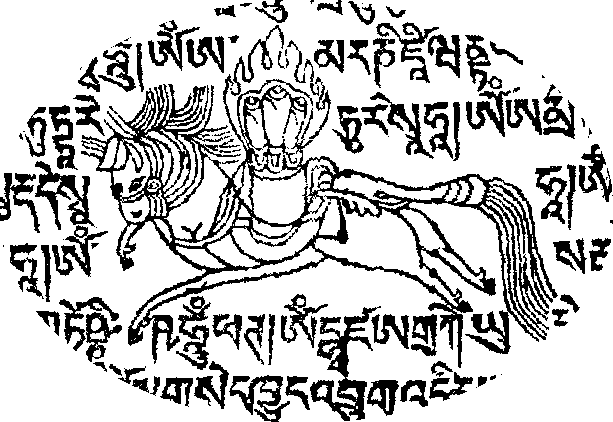
(We continue to listen to the Dalai Lama as he tells of his thoughts on remarkable shamanic phenomena in Tibetan Buddhism!)
" I am well aware, however, of the danger of tying spiritual belief to any scientific system. For whilst Buddhism continues to be relevant two and a half millennia after it's inception, the absolutes of science tend to have a relatively short life. This is not to say that I consider things like the oracle and the ability of monks to survive nights spent out in freezing conditions to be evidence of magical powers. Yet I cannot agree with our Chinese brothers and sisters, who hold that Tibetan acceptance of these phenomena is evidence of our backwardness and barbarity. Even from the most rigorous scientific viewpoint, this is not an objective attitude.
At the same time, even if a principle is accepted, it does not mean that everything connected with it is valid. By way of analogy, it would be ludicrous to follow slavishly and without discrimination every utterance of Marx and Lenin in the face of clear evidence that Communism is an imperfect system. Great vigilance must be maintained at all times when dealing in areas about which we do not have great understanding. This, of course, is where science can help. After all, we consider things to be mysterious only when we do not understand them.
So far, the results of the enquiries I have described have been beneficial to all parties. But I realise that these are only ever as accurate as the experiments employed to achieve them. Furthermore, I am aware that not finding something does not mean that it does not exist. It only proves that the experiment was incapable of finding it. (If I have a non-metallic object in my pocket which is not picked up by a metal detector, it does not mean that my pocket is empty.) This is why we must be careful in our investigations, especially when dealing in an area where scientific experience is slight. It is also important to keep in mind the limitations imposed by nature itself. For example, whilst scientific enquiry cannot apprehend my thoughts, not only does this not mean that they are non-existent, but also that some other method of investigation cannot discover something about them- which is where Tibetan experience comes in. Through mental training, we have developed techniques to do things which science cannot yet adequately explain. This, then, is the basis of the supposed 'magic and mystery' of Tibetan Buddhism.
In early 1959, as tension began to mount towards that final cataclysm, I heard of a PLA memorandum sent to Chairman Mao. It reported that the Tibetans were unhappy with the continued presence of the PLA, adding that there was so much disobedience that all the prisons were full. Mao supposedly replied that there was no need to worry. The feelings of Tibetans could be disregarded: they were irrelevant. As to the disobedience, the authorities must be prepared to put the whole population in prison if need be. Therefore, room would have to be made. What a contrast from the old days when I could recognise every prisoner in Lhasa and considered each to be my friend.
Another story from around this time concerned Mao's reaction to a report sent to him after the March uprising, saying that order had been restored. 'And what about the Dalai Lama', he replied, ' In that case we have lost the battle'. After that, all my information concerning the Great Helmsman came from reading newspapers and listening to the BBC World Service news broadcasts. I had no contact whatever with Peking; nor did the Tibetan Government in Exile, until after Mao's death in September of 1976.
At that time I was in Ladakh, part of the remote northern Indian province of Jammu and Kashmir, where I was conducting a Kalachakra initiation. On the second of the ceremony's three days, Mao died. On the third day, it rained all morning. But, in the afternoon there appeared one of the most beautiful rainbows I have ever seen. I was certain that it must be a good omen. However, despite this auspicious sign, I did not expect the dramatic pace of change that followed in Peking. Almost immediately, the Gang of Four, led by Mao's wife, Jiang Qing, was arrested. It quickly became apparent that it was they who had effectively ruled China behind the ailing Chairman's back for the past several years, pursuing viciously radical policies and supporting a continuation of the Cultural Revolution.
Then, in 1977, Li Xiannian, at the time President of the People's Republic of China, was reported as saying that although it had achieved much, the Cultural Revolution had simultaneously caused some damage. This was the first sign that the Chinese leadership had at last begun to face reality. It was followed by a conciliatory statement about Tibet when, in April of that year, Ngabo Ngawang Jigme (By now a high ranking member of the administration of Peking), publicly announced that China would welcome the return of the Dalai Lama and his 'followers who fled to India'. Since the 1960's the Chinese had been calling for all who had left Tibet to return, saying that they would be welcomed with open arms."
( Some hope of change for the better in Tibet! I promise to add more tomorrow...)
 *( please click here to read of the day with me )
 * This is from the book Freedom in Exile The Autobiography of the Dalai Lama by Tenzin Gyatso, the fourteenth
Dalai Lama of Tibet.

 ( Please see my spinning for you!) ( Tahshi Deleh gentle one! Kehrahng kusu debo yinpeh? I began the day heading up gang rinpoche ngah tso gi to the Grove to continue spraying. Two as one we've completed the spraying for the week! After that I trimmed around the electric fence then cleared around the trunks of trees and the native plants,put on more tree ties, increased the size of fences around some of the trees, and generally did things that I hadn't been able to get to yet this season. After that I rested by your Medlar tree as usual before returning to our studio to spin for you then to work on the printing block which with we two working as one pulling strongly and patiently together is going quite well! We've completed the eighth row now! After that I worked on our a land of Tibet. Two as one we've fixed a few more mistakes on the pages as usual.I'm going to put the pages up on our infosite;I'll put this up for now so we can rest.
 And so, as always we'll continue two as one on to tomorrow
my one gentle beautiful patient swift dream bright
long dark mane in sunlight
so for now I bid goodnight...Simjah Nahngo!)