
Through My Eyes
Saturday June 11
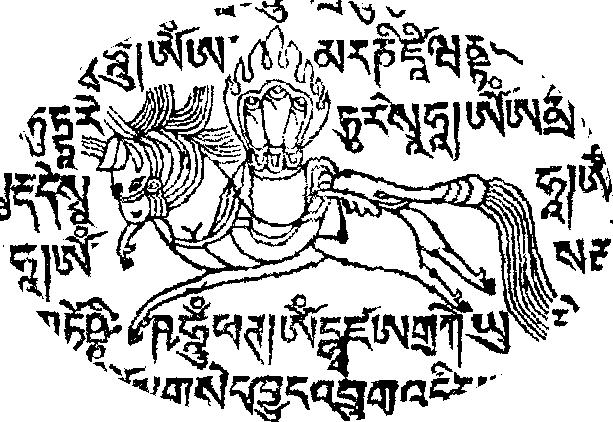
(We continue to listen to the Dalai Lama as he tells of his spiritual practice!)
" To engender altruism, or compassion, in myself, I practise certain mental exercises which promote love towards all sentient beings, including especially my so-called enemies. For example, I remind myself that it is the actions of human beings rather than human beings themselves that make them my enemy. Given a change of behaviour, that same person could easily become a good friend.
The remainder of my meditation is concerned with Sunya or Emptiness, during which I concentrate on the most subtle meaning of Interdependence. Part of this practice involves what is termed 'deity yoga', lhai naljor, during which I use different mandalas to visualise myself as a succession of different 'deities'. This should not, however, be taken to imply belief in independent external beings. In so doing, I focus my mind to the point where it is no longer preoccupied with the data produced by the senses. This is not a trance, as my mind remains fully alert; rather it is an exercise in pure consciousness. What exactly I mean by this is hard to explain: just as it is difficult for a scientist to explain in words what is meant by the term 'space-time'. Neither language nor every-day experience can really communicate the meaning experience of 'pure mind'. Suffice to say that it is not an easy practice. It takes many years to master.
One important aspect of my daily practice is its concern with the idea of death. To my mind, there are two things that, in life, you can do about death. Either you can choose to ignore it, in which case you may have some success in making the idea of it go away for a limited period of time, or you can confront the prospect of your own death and try to analyse it and, in so doing, try to minimise some of the inevitable suffering that it causes. Neither way can you actually overcome it. However, as a Buddhist, I view death as a normal process of life, I accept it as a reality that will occur while I am in Samsara. Knowing that I cannot escape it, I see no point in worrying about it. I hold the view that death is rather like changing one's clothes when they are tired and old. It is not an end in itself. Yet death is unpredictable-you do not know when and how it will take place. So it is only sensible to take certain precautions before it actually happens.
As a Buddhist, I further believe that the actual experience of death is very important. It is then that the most profound and beneficial experiences can come about. For this reason, many of the great spiritual masters take release from earthly existence- that is, they die- whilst meditating. When this happens, it is often the case that their bodies do not begin to decay until long after they are clinically dead.
My spiritual 'routine' changes only when I undertake a retreat. On these occasions, in addition to my normal daily practice, I also perform special meditations. This takes the place of my usual period of meditation and of my study of Buddhist philosophy between breakfast and noon. These I shift to the afternoon. After tea, there is no change. However, there are no hard and fast rules. Sometimes, because of external pressures, I am compelled to deal with official matters, or even to give audiences whilst on retreat. In that case, I may sacrifice some sleep in order to be able to fit everything in.
The purpose of undertaking a retreat is to enable a person to concentrate fully on inner development. As a rule, my opportunities for doing so are very limited. I am lucky if I can find two periods of a week in any given year, although occasionally I have managed a month or so. In 1973, I had a strong desire to undertake a three-year retreat, but unfortunately circumstances did not permit. I would still like very much to do this one day. In the meantime, I have to make do with just short battery-charging sessions, as I call them. A week is not long enough to make any actual progress or to develop in any way, but it is just sufficient to allow me to recharge myself. It takes much longer periods actually to train the mind to any extent. This is one of the reasons why I consider myself to be very much in the primary grade of spiritual development.
Of course, one of the main reasons I have so little time for retreats is the amount of travelling that I do nowadays, though I do not regret this. By travelling, I am able to share my experiences and hope with many more people that would otherwise be possible. And if, when I do so, it is always from the viewpoint of my being a Buddhist monk, this does not mean I believe that it is only by practising Buddhism that people can bring happiness to themselves and others. On the contrary, I believe that this is possible even for people who have no religion at all. I only use Buddhism as an example because everything in life has confirmed my belief in its validity. Besides, as a monk since the age of six, I have some knowledge in this field!
I am often asked questions about the so-called magical aspects of Tibetan Buddhism. Many westerners want to know whether the books on Tibet by people like Lobsang Rampa and some others, in which they speak about occult practices,are true. They also ask me whether Shambala ( a legendary country referred to by certain scriptures and supposed to lie hidden among the northern wastes of Tibet) really exists. Then there was the letter I received from an eminent scientist, during the early 1960's, saying he had heard that certain high lamas were capable of performing supernatural feats and asking whether he could conduct experiments to determine whether this was so."
( The wondrous shamanic aspects of Tibetan Buddhism! I promise to add more tomorrow...)
 *( please click here to read of the day with me )
 * This is from the book Freedom in Exile The Autobiography of the Dalai Lama by Tenzin Gyatso, the fourteenth
Dalai Lama of Tibet.


 ( Please see my spinning for you!) ( Tahshi Deleh gentle one! Kehrahng kusu debo yinpeh? I began the day by heading up gang rinpoche ngah tso gi to wander about taking pictures then to continue spraying. Two as one we've completed much of it but there's quite a bit to go. It was something of a sundance up there as it was very hot particularly in the clothes I wear for spraying! Also I think that the sandy soil up there tends to heat up quite a bit more. Anyway after I returned to our studio as it was beginning to rain. After taking a nap and working a bit on the monthly pages, I headed back up to continue with the trimming. We've completed this for the week! After that I rested by your Medlar tree as usual before returning to our studio to spin for you then to work on the printing block which with we two working as one pulling strongly and patiently together is going quite well! After that I worked on our a land of Tibet. Two as one we've fixed a few more mistakes on the pages as usual. I'm going to put the pages up on our infosite; I'll put this up for now so we can rest.
 And so, as always we'll continue two as one on to tomorrow
my one gentle beautiful patient swift dream bright
long dark mane in sunlight
so for now I bid goodnight...Simjah Nahngo!)