
Through My Eyes
Saturday October 8
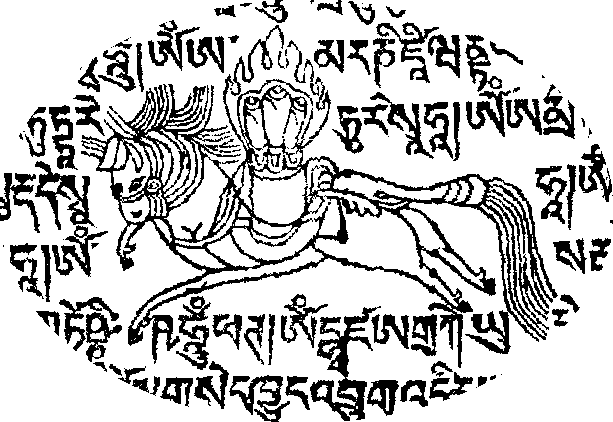
(We continue to listen to the Dalai Lama as he tells of China's renewal of repression and the beginning of the Chinese population influx into Tibet.)
" Between 1981 and 1987, the number of visitors to Tibet rose form 1,500 to 43,000 per year. From those who subsequently contacted us in exile, we learned that there was little substance to China's supposed 'liberalism'. Tibetans were still denied free speech. And although in private people made clear their opposition to China's occupation of our country, they dared not do so in public. Furthermore, their access to information was strictly controlled, as was the practice of religion. It took little objectivity to see that Tibet was a police state where people were terrorised into submission. Thus they continued to live in fear, despite the promises of genuine reform in the immediate aftermath of Mao's death. And now they had to contend with he increasing influx of Chinese immigrant who threatened to swamp them.
Many of the visitors that I met subsequently said they had basically been pro-China before they went, only to have their ideas overturned by what they saw. Similarly, a lot said that,although they were basically uninterested in politics, they now felt compelled to change their stance. I remember in particular a Norwegian man who told me that initially he had admired the Chinese for their destruction of religion. But now that he had been back to Lhasa for a second time he had seen what was really happening. Was there anything, he asked, that he could do to help my people? I replied to him, as I reply to all those who have been to Tibet and ask this question, that the best thing he could do was tell the truth of what he had seen to as many people as possible. That way, the world's knowledge of Tibet's plight is gradually increased.
Following what I learned both from the new arrivals and those tourists I met, I was not greatly surprised to hear, in September 1983, of a new bout of repression in China and Tibet. Executions were reported in Lhasa, Shigatse and Gyantse, with further arrests in Chamdo and Karze. Ostensibly, the crack-down (which covered China as well) was aimed at 'criminal and anti-social elements' but, this clearly meant dissidents. However, although this seemed to indicate a hardening in the attitude of the Chinese authorities, there was a positive aspect to the news. For the first time, information about China's activities in Tibet was disseminated by the international press, which had recently been permitted to send correspondents to Tibet.
Feeling that this new terror must signal a return a return to the old, harsh methods of the Mao era, the refugee population reacted strongly. Mass demonstrations of protest were held in Delhi and throughout the settlements in India. For my own part, I felt it was too soon to tell whether this brutality merely represented a backlash by conservatives against Deng Xiaoping's regime, or whether Tibet was re-entering a period of darkness. But it was evident that the advance party to my visit could not now take place. Subsequently my own did not materialise.
By May 1984, it had become clear that China's policy with regard to Tibet had indeed undergone a major shift. In direct contradiction to Hu Yaobang's pledge to reduce by eighty-five percent the number of Chinese officials in Tibet, a massive effort to encourage immigration began. In the name of 'development', 60,000 skilled and unskilled workers were recruited to start the process and given financial guarantees, housing assistance and the promise of home-leave entitlements. Simultaneously, due to the relaxation of travel restrictions within China itself, many others followed as private individuals, lured by the prospect of finding work. Thus, in accordance with the Tibetan saying that where there is one Chinese, ten will follow, a huge influx ensued- and continues unabated.
In late autumn of that same year, Mrs Gandhi was assassinated and the Tibetan refugees lost a true friend. I was very shocked when I heard the news, en route to Delhi from London-not least because I was due to have lunch with here an J. Krishnamurti that very day. She was succeeded in office by here son Rajiv, who, as a young leader, had great determination to do something for his country and whatever he could for the Tibetan exile community.
Rajiv Gandhi is a man with a friendly, gentle nature and a very good heart. I well remember the first time I saw him. During my 1956 visit to India, I was invited to lunch at the residence of his grandfather, Pandit Nehru. When the Prime Minister showed me to the garden, I noticed two small boys playing around a tent with a large firework that they were trying unsuccessfully to launch into space. This was Rajiv and his elder brother Sandjay. Recently, Rajiv reminded me that I had tied them both inside the tent, much to their amusement.
Less than a year later, Tibet lost one of it's very greatest supporters when Lobsang Samten died. He was only fifty four. In a way, despite my profound sorrow, I was not much surprised at this."
( In the movie Cry of the Snow Lion one of the narrators indicated that on his visit to Lhasa he at first was wondering where all the Tibetans were as he saw only Chinese on the streets. I promise to add more tomorrow...)
 *( please click here to read of the day with me )
 * This is from the book Freedom in Exile The Autobiography of the Dalai Lama by Tenzin Gyatso, the fourteenth
Dalai Lama of Tibet.


 ( Please see my spinning for you!) ( Tahshi Deleh gentle one! Kehrahng kusu debo yinpeh? I began the day in our studio tidying up and working with the equipment as it was needed! It was getting congested with all the packing material, power cords, manuals and the like. It rained throughout the day and is still raining so it was a good day for this. In general there remains a lot of organizing to do generally. After that I headed out to wander about for awhile in the rain taking pictures. The rain gauge is almost full now, the stream is almost to the top of it's banks and it's still raining! There's an awesome giant puffball growing on the way to Mom's garden; I'll bring us a picture of it soon. Then I returned to our studio to spun for you then to work a bit on the sculpture of Tara Drolma and our a land of Tibet. Two as one we've fixed a few more mistakes on the pages. I'm going to put the pages up on our infosite; I'll put this up a bit early so we can rest.
 And so, as always we'll continue two as one on to tomorrow
my one gentle beautiful patient swift dream bright
long dark mane in sunlight
so for now I bid goodnight...Simjah Nahngo!)