
Through My Eyes
*
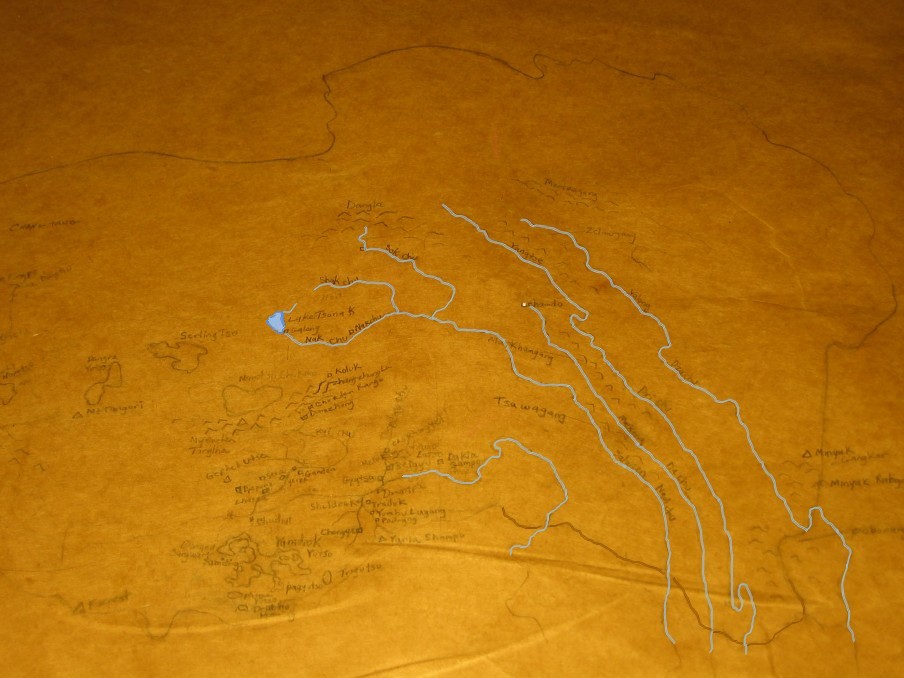
We're in our coracle at Chamdo again in Kham the Chuzi gangdruk! We're still getting a sense of this rugged place. The Salween is the closest of the rivers to Lhassa and the Brahmaputra. One of the routes from Lhassa to Chamdo goes up past Damzhung and Chorten Rango to the south of Namtso Chukmo then rises up through the Zhungzhang la pass through the Nyenchen Thanglha mountains to reach the Nak chu, one of the tributaries of the Salween. The Salween is called the Nak chu also. Anyway the Shak chu enters somewhat farther east followed by the Shok chu which comes down from the Danglha mountains. The town of Nakchu has become a trading center for the the entire general area which is northern nomadic region known as Hor to Tibetans. It get's more rain than the Chang Tang , mostly in the summer when 500- 1000 mm between 19 - 39 inches falls. I think we get about 30 -35 inches a year on our precious snow mountain so the Chuzi gangdruk is roughly comparable.Kham has many festivals and at Nakchu is a fabulous horse festival where thousands of Tibetans come to celebrate each year! In general this is a place of many kingdoms and tribes because of the rugged topography so there are lot's of festivals with local traditions and dress. We've learned something of the Tibetans in Kham, the Khampas from the Dalai Lama's and Art Perry's books. Kham put up a tremendous resistance to Chinese invasion both during the Chinese dynasties and later during the invasion by the PLA in 1949 and there were many tragedies here. Two as one we've figured out that the Minyak Rabgang mountains in the lower reaches of the Yalong, the Dza chu are in fact where we thought they were. Minyak Gangkar is in the northern part of the range which is a remarkable complex of mountains; with many over 6000 meters, between 19-20 thousand feet and some 45 glaciers! There's a lot more to add but as usual two as one we'll add to the notes later beautiful one!

* courtesy of A Luminous Diamond (Bright) Crystal Show productions. The information for
the sketches is courtesy of the Footprint Tibet handbook by Gyurme Dorje.
 ( please click here to return to my spinning for you!)