
Through My Eyes
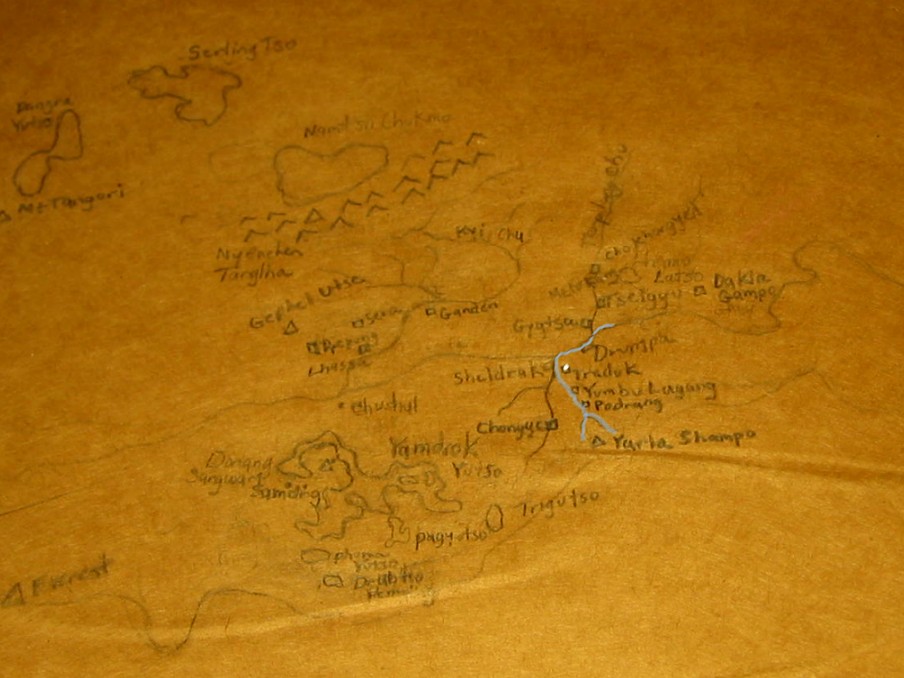
*
We're at Tradruk! Tradruk is named after the falcon that was created shamanically by King Songsten Gampo in his meditations to overcome a dragon in the vicinity that was preventing the building's construction. You probably remember when Sarangerel mentioned the importance of focusing the mind in this way for shamanic activity! Tradruk served the same purpose as the Jokhang in that it acted to redirect the energies of the plateau to make Tibet a safer place and was sited on what was considered to be the left elbow of the ogress. It was ransacked during the reign of King Langdarma during a terrible period of Tibetan history that marked the end of the Kings in Tibet. Great Kings and Queens had reigned after Songsten Gampo but for some reason King Langdarma sought to purge Buddhism from Tibet destroying temples and persecuting lineage holders throughout Tibet. He was assassinated by a monk with a bow and arrow. In the chaos that followed the lineages were preserved and revived only in the remotest parts of Tibet such as in the Sutlej Valley by the King Yeshe O and others. Hence the importance of the treasure finders, the Tertons who could find the scriptures hidden away by themselves in prior existences and Tulkus, reincarnated wisdom teachers who could return to pass the teachings on. Tradruk has lots of fascinating things for us to see together to inspire us! Among them are some remarkable tangkas. Tangkas are large painted banners and some are as large as the side of a building. One of them, depicting Padmapani, a form of Avalokiteshvara, is composed of 29,000 pearls! They were originally in Nedong Tse Tsokpa monastery in the south of Tsetang but were brought to Tradruk. The monastery was destroyed in the cultural revolution by the Chinese governent so it is fortunate they were moved! It's now quite late so two as one we'll add to the notes a bit later beautiful one! In the meanwhile we can rest in the Metoktang our plain of flowers!

* courtesy of A Luminous Diamond (Bright) Crystal Show productions. The information for
the sketches is courtesy of the Footprint Tibet handbook by Gyurme Dorje.
 ( please click here to return to my spinning for you!)