
Through My Eyes
Saturday March 5
(We continue to listen to the Dalai Lama as he tells of progress at the Bylakuppe refugee camp! )
" Fighting broke out on 1 September 1965.
Because Dharamsala lies less than a hundred miles from the Indo Pakistan border, I was able to see at first hand the tragic effects of battle. Not long after the fighting had begun, I left home for one of my frequent visits to the settlements in the south. It was night and there was a total blackout in force. We were compelled to drive the three hours to Pathankot railway station without headlights. The only other traffic on the road was military and I remember thinking that it is a very sad state of affairs when ordinary citizens are forced into hiding and the 'defence forces' are called forward. In reality, of course, these are the same people- human beings like myself.
When at last we reached the station, after a difficult journey, I could hear the heavy shelling of Pathankot airport in the near distance. At one point, I heard jets shrieking overhead and then, moments later, the stutter of anti-aircraft tracers spat up into the sky. The noise was terrifying and I was quite frightened, though I am pleased to say that I was not the only one. I have never been on a train that pulled out of a station as fast as ours did last night.
On arrival in the south, I went first to Bylakuppe, where I saw the original refugee settlement, reaching it on 10 September. By now it was home to more than 3,200 people. There was also permanent housing, each building being constructed of brick and roofed with local tiles, and work on the drilling of wells and cutting down of trees was completed. According to the original plan, agricultural work was now beginning in earnest. Each person had been given nominal ownership of one acre of land, though really it was farmed co-operatively, with a small proportion kept over for private kitchen gardens which produced seasonal fruits and vegetables. The main crops were to be rice, maize and ragi (millet). I was very happy to see such progress. It confirmed my belief in the tremendous power of a positive outlook when coupled with great determination.
Overall, I found the situation considerably improved. No long did I have to confront people who were on the edge of despair. Nor did I have to make promises of future prosperity which I myself could hardly believe. But although there were signs that their tenacity was paying off, the life of the settlers was still extremely hard.
In the earliest days of planning the resettlement programme with the Indian Government, we had hoped that the refugees would be self-sufficient within five years. Thereafter, it was intended that the Tibetans would begin to contribute to India's economy by raising an agricultural surplus which could then be sold. However, our optimism failed fully to acknowledge that the workforce was completely untrained. Few of the people who worked on the land had any knowledge of farming. Former tradesmen, monks, soldiers, nomads and simple villagers who knew nothing were all pitched into this new enterprise, regardless.
And of course, agriculture in the Indian tropics is a very different proposition from agriculture at Tibet's high altitudes. So even those who did know something about it had to learn entirely new methods, from working with bullocks to using and maintaining tractors. Thus, even after almost five years, conditions in the camps were still very primitive.
Yet, looking back, I see that in some ways the mid-1960's were a high point in the Tibetan resettlement programme: the majority of the necessary land clearance had been done, most of the refugees had access to basic medical attention, courtesy of the International
"Red Cross and others- and the farm machinery was still fairly new, whereas today it is old and in need of replacement.
On this occasion in 1965, I remained for a week or ten days at Byalakuppe, after which I took the opportunity to vistt Mysore, Ooramacund and Madras by road before proceeding to Trivandrum, capital of Kerala, India's most literate state. I was invited to reside with the Governor. In the end, my stay turned out to be one of several weeks on account of the war in the north, which continued to look very dangerous: two bombs had already fallen on Dharamsala. however, the time was not wasted.
It so happened that my room in the Rajbhavan, the Governor's residence, looked directly on to the kitchens opposite. One day I chanced to see the slaughter of a chicken, which was subsequently served up for lunch; as it was having it's neck wrung,I thought of how much suffering the poor creature was enduring. The realisation filled me with remorse and I decided that it was time to become a vegetarian. As I have already mentioned, Tibetans are not as a rule, vegetarians, because in Tibet vegetables are often scarce and meat forms a large part of the staple diet. Nevertheless, according to some Mahayana, Buddhist texts, monks and nuns should really be vegetarians. "
( A difficult thing for one meditating on compassion to witness. I promise to add more tomorrow...)
 *( please click here to read of the day with me )
 * This is from the book Freedom in Exile The Autobiography of the Dalai Lama by Tenzin Gyatso, the fourteenth
Dalai Lama of Tibet.

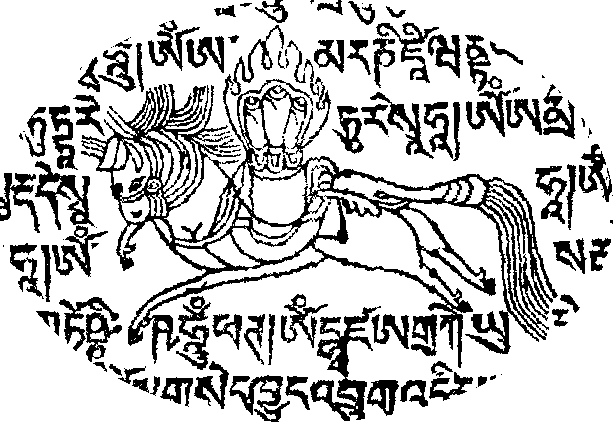
 ( Please see my spinning for you!) ( Tahshi Deleh gentle one! Kehrahng kusu debo yinpeh? I began the day in our studio spinning for you then worked a bit more on the printing block which with we two working as one pulling strongly and patiently together is going quite well! We've begun drawing the design on to the printing block which will take longer since we've much more script and images this time! After that I headed up gang rinpoche ngah tso gi to continue our work there. We're working more slowly there than last year which is fine as a lot involves working on the highest part of the ladder! After that I rested by your Medlar tree before heading to our studio to work on our a land of Tibet. Two as one we've fixed a few more mistakes on the pages as usual. I'm going to put the pages up on our infosite;I'll put this up a bit early so we can rest.
 And so, as always we'll continue two as one on to tomorrow
my one gentle beautiful patient swift dream bright
long dark mane in sunlight
so for now I bid goodnight...Simjah Nahngo!)