
Through My Eyes
Saturday July 26
( And, two as one we are travelling to the Dalai Lamas birthplace! )
" I was born on 6 July 1935 and named Lhamo Thondup. This means, literally, 'Wish fulfilling Goddess'. Tibetan names of people, places and things are often picturesque in translation. For example, Tsangpo, the name of one of Tibet's most important rivers- and the source of India's mighty Brahmaputra- means 'The Purifier'. The name of our village was Takster: Roaring Tiger. It was a small and poor settlement which stood on a hill overlooking a broad valley. It's pastures had not been settled or farmed for long, only grazed by nomads. The reason for this was the unpredictability of the weather in that area. During my early childhood, my family was one of twenty or so making a precarious living from the land there.
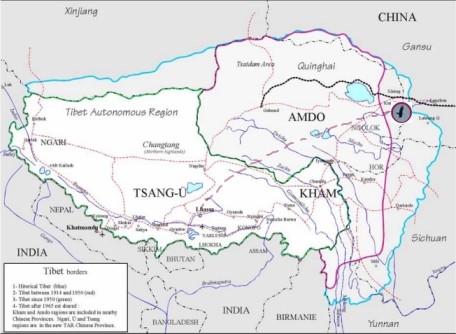
Takster is situated in far north-eastern Tibet, in the province of Amdo. Geographically, Tibet can be divided into four principal areas. To the north-west lies the Chang-Tang, an area of frozen desert which runs east-west for over eight hundred miles. It is almost devoid of vegetation and only few hardy nomads live amidst its desolation. To the south of the ChangTang lie the provinces of U and Tsang. This area is bordered to the south and south-west by the mighty Himalayas. To the east of U-Tsang lies the province of Kham, which is the most fertile and hence the most populous region in the country. To the north of Kham is situated Amdo. On the eastern borders of both Kham and Amdo lies Tibet's national boundary with China. At the time of my birth, a Muslim warlord, Ma Pu-feng, had recently succeeded in establishing in Amdo a regional government loyal to the Chinese republic.
My parents were small farmers: not peasants exactly, for they were not tied to any master; but they were by no means nobility. They leased a small amount of land and worked it themselves. The main crops in Tibet are barley and buckwheat and my parents grew both of these, together with potatoes. But quite often their year's work went to ruin due to heavy hailstorms or to drought. They also kept a number of animals, which were a more reliable source of produce. I remember that we had five or six dzomos ( a cross between a yak and a cow) for milking and a number of footloose chickens for laying. There was a mixed flock of perhaps eighty sheep and goats, and my father nearly always had one or two or even three horses, of which he was very fond. Finally, my family kept a couple of yaks.
The yak is one of Nature's gifts to mankind. It can survive at any altitude above 10,000 feet, so it is ideally suited to Tibet. Below that they tend to die. Both as a beast of burden and as a source of milk ( in the case of the female which is called a dri) and meat, the yak is truly a staple of high-altitude farming. The barley which my parents grew is another Tibetan staple. When roasted and ground down into a fine flower it becomes, tsampa and, even in exile, I continue to have it every day. It is not eaten as flour of course. You must first combine it with a liquid, usually tea, but milk (which I prefer) or yoghurt or even chang (Tibetan beer) will do. Then, working it with your fingers around your bowl, you roll it into small balls. Otherwise it can be used as a base for porridge. To a Tibetan, it is very tasty though, in my experience, few foreigners like it. The Chinese in particular do not care for it at all.
Most of what my parents grew on the farm was used solely to feed us. But my father would occasionally trade grain or a few sheep either with passing nomads or down at Siling, the nearest town and capital of Amdo,which lay three hours away by horse."
( Actually, potatoes were brought to Tibet by Europeans who in turn got it from South America perhaps even from the Incas! This enabled farmers to cultivate terraces high in the Himalayas where they were not previously able to farm. I promise to add more tomorrow...)
 *( please click here to read of the day with me )
 * This is from the book Freedom in Exile The Autobiography of the Dalai Lama by Tenzin Gyatso, the fourteenth
Dalai Lama of Tibet.


 ( Please see my spinning for you!) ( Tahshi gentle beautiful one! I began the day working on our lotus blossoms, spinning ,and working on the website. You may notice I've put a link to the Through My Eyes page on the front page of the website. It's set up so you can go right to the recent days without having to go through all the days to get to this week which I thought might be really helpful if you now have to use a different computer.
 Also,as I found myself saying to the neighbor whose phone line I borrowed, lots of people are now looking at the site. Some of them may sincerely feel this is worthwhile and I don't think we mind sharing with them! Others are,never mind! I'll just spin for you gentle one and try to say no more about it! I'm also worked on the Friends section some more. Here's the small map of Tibet again. We were getting a pretty good geography lesson from the Dalai Lama actually! Takster is up by Kumbum so we are travelling from Lhassa up to Amdo province. Dharmasala is in India a little off the map to the west of Ngari. India is actually a very large country! I had mentioned that I was going to tell you how I found our sacred place. I was coming down the hill at twilight having said goodnight to the trees and suddenly had a longing sad sort of feeling, as though I had forgotten some of the trees. I started up the hill and realized I was being drawn to a different spot. I experienced it as a sort of welcoming energy. I walked in different directions, noticing when the energy grew stronger and was gradually led right to the spot. I sat down and knew I was being welcomed to a place that had been sacred to Native Americans hundreds of years before. There's more to the story but I will tell you of it later. Being guided by energy has been used by Native Americans and Pioneers in a technique called dowsing which has often been used to find water( you may know of this already) but which also has other uses. We can read of it together in a fascinating book I found called The Moment that Matters which is written by a master in the art of spiritual dowsing.
It's getting a bit late so I'll pause for now and rest. We can read from the Tibetan language book together tomorrow.
And so, as always we'll continue two as one on to tomorrow
my one beautiful patient dream bright
long dark mane in sunlight
so for now I bid goodnight...Simjah Nahngo!)