
Through My Eyes
Saturday August 16
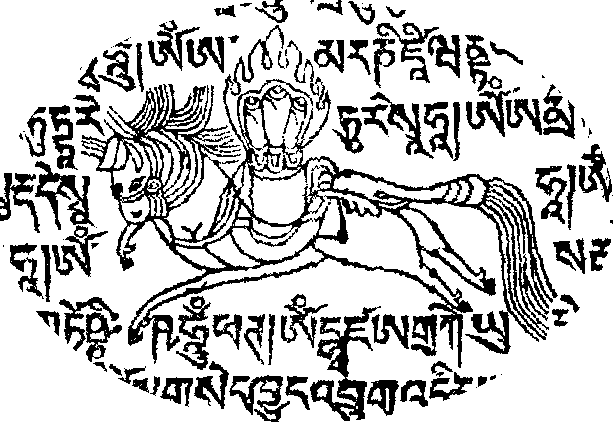
( Still in Takster as the Dalai Lama speaks of his childhood and describes the history of Tibet and Buddhism.)
" One thing that I remember enjoying particularly as a very young boy was going into the hen coop to collect the eggs with my mother and then staying behind. I liked to sit in the hens' nest and make clucking noises Another favorite occupation of mine as an infant was to pack things in a bag as if I was about to go on a long journey 'I'm going to Lhasa, I'm going to Lhasa', I would say. This, coupled with my insistence that I be allowed always to sit at the head of the table, was later said to be an indication that I must have known that I was destined for greater things. I also had a number of dreams as a small child that were open to a similar interpretation, but I cannot say categorically that I knew of my future all along. Later on, my mother told me several stories which could be taken as signs of high birth. For example, I never allowed anyone but her to handle my bowl. Nor did I ever show fear of strangers.
Before going on to tell about my discovery as Dalai Lama , I must first say something about Buddhism and its history in Tibet. The founder of Buddhism was a historical figure, Siddhartha, who came to be recognized as the Buddha Shakyamuni. He was born more than 2500 years ago. His teachings, now known as the Dharma, or Buddhism, were introduced to Tibet during the fourth century A.D. They took several centuries to supplant the native Bon religion and become fully established, but eventually the country was so thoroughly converted that Buddhist principles governed all society , at every level. And whilst Tibetans are by nature quite aggressive people and quite warlike, their increasing interest in religious practice was a major factor in bringing about the country's isolation. Before then, Tibet possessed a vast empire, which dominated Central Asia with territories covering large parts of northern India, Nepal and Bhutan in the south.. It also included much Chinese territory. In 763 A.D., Tibetan forces actually captured the Chinese capital, where they extracted promises of tribute and other concessions. However, as Tibetans' enthusiasm for Buddhism increased, so Tibet's relations with her neighbors became of a spiritual rather than a political nature. This was especially true of China, where a 'priest-patron' relationship developed. The Manchu Emperors, who were Buddhists, referred to the Dalai Lama as King of expounding Buddhism."
( A remarkable evolution! I promise to add more tomorrow...)
 *( please click here to read of the day with me )
 * This is from the book Freedom in Exile The Autobiography of the Dalai Lama by Tenzin Gyatso, the fourteenth
Dalai Lama of Tibet.


 ( Please see my spinning for you!.) ( Tahshi gentle one! I spent the morning carving our lotus blossoms and working on the sound recording software. It works now! Then I went to the field below the Grove and cut some more mulch. I want to bring up as much as possible while the fields are still able to recover easily. This is hard weather to work in though; still very hot and muggy. I've done a bit more studying in our Tibetan language book. We can read a bit more from it tomorrow and I'll bring us the spinning song that I was talking about. The melody came to me in the usual quiet shamanic sort of way of course. I'll put this up for now so we can rest.
 And so, as always we'll continue two as one on to tomorrow
my one beautiful patient dream bright
long dark mane in sunlight
so for now I bid goodnight...Simjah Nahngo!)