
Through My Eyes
Saturday July 3
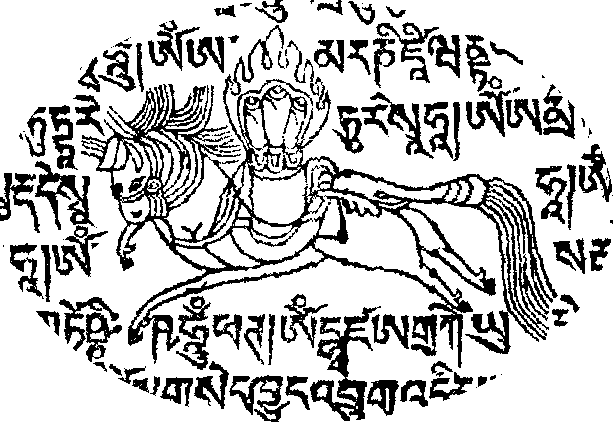
(We continue to listen to the Dalai Lama as he tells of his return to Tibet from Peking!)
" Besides, as far as I was concerned, a positive approach was the only sensitive one to take. There was no point in being negative: that only makes a bad situation worse. Not that my optimism was shared by many of my entourage. Few of them had gained a good impression of China and they were afraid that the rigid methods of the Communists would lead to oppression in Tibet. They were further disturbed by a story then circulating about a high official in the Chinese Government, called Gan Kung. It was whispered that he had been critical of Liu Shao-ch'i and for this had been murdered in a most horrible way.
It was not long before I began to have fresh doubts of my own. When I visited Tashikiel in far eastern Tibet, there was a huge turnout of people. Many thousands had travelled to be able to see me and pay their respects. I was deeply moved by their great devotion. However, I was devastated to hear, some time later, that the Chinese authorities had mislead people into believing that I would arrive a week later than I actually did. They lied about the date in order to prevent people from seeing me. As a result, thousands more turned up when I left.
A further cause for unhappiness was the paranoia of the Chinese concerning my personal safety. When I visited my home village, they insisted that I should not accept food from anyone but my own cooks. This meant that I could not receive any of the offerings brought to me by my own people, even though some of them were from my own family who still lived in Takster. As if any one of these simple,devout, humble people would ever take it into their heads to try to poison the Dalai Lama. My mother was deeply upset. She did not know what to tell them. And when I spoke to Tibetans there, asking about their living conditions, they replied that ,'Thanks to Chairman Mao, to Communism and the People's Republic of China, we are very happy' -but with tears in their eyes.
Throughout my journey back to Lhasa, I received as many people as possible. Unlike China, this was not difficult. Thousands came, bringing their sick and old, just to catch a glimpse of me. A lot of Chinese attended these gatherings as well, which gave me the opportunity to express the need for them to understand the Tibetan mentality. In doing so, I took the trouble to find out which were Party members and which were not. Experience had taught me that the former were on the whole, more straightforward.
The attitude of the Chinese authorities in Tibet towards me was very interesting. On one occasion, an official said, 'The Chinese people do not love Chairman Mao as much as the Tibetans love the Dalai Lama.' On another, a guard, who was throwing his weight around in a very brutal manner, came over to my jeep and demanded to know where the Dalai Lama was. At the reply of 'Here', he took off his hat and asked for a blessing. And when I had left Chengdu, many of the Chinese officials who accompanied me throughout my visit wept to see me go. I had similarly warm feelings towards them: despite our differences of opinion, we had developed a strong, personal relationship.
Seeing the country people of Tibet after so many months allowed me to look afresh at the differences between them and their Chinese counterparts. For a start, you could tell just by comparing their faces that the Tibetans were much happier. This was due to a number of cultural factors I feel. Firstly, the relationship between landlord and serf was much milder in Tibet than in China and conditions for the poor were much less harsh. Secondly, in Tibet there was never anything like the barbarisms of foot-binding or castration, which until recently had been widespread throughout China. However, I think that these points were lost on the Chinese, who looked on our feudal system as a replica of their own.
Shortly before reaching Lhasa, I met up with Chou En-lai, who had flown to a place in Kham that had suffered an earthquake. It was a curious encounter in which he said some positive things about religion. I still wonder why, as this was very much out of character. Perhaps he was speaking on Mao's instructions, trying to repair the damage done at our final meeting."
( Chinese government propaganda still falsely portrays the feudal situation in Tibet as having been very inhumane. I promise to add more tomorrow...)
 *( please click here to read of the day with me )
 * This is from the book Freedom in Exile The Autobiography of the Dalai Lama by Tenzin Gyatso, the fourteenth
Dalai Lama of Tibet.

 ( Please see my spinning for you!) ( Tahshi Deleh gentle one! Kehrahng kusu debo yinpeh? I began the day in our studio spinning for you then to the stream to clear the pump. Then I headed up to the Grove to continue work on the water system adding drippers to the lines. It's working just fine which is good because it would be hours of watering with a hose! The filter in the main head assembly clogs up fairly quickly as the water has a fair bit of sediment in it so it has to be washed off every few hours; I have it set up so the water can be switched to a set of hoses so that it isn't necessary to go all the way back to the studio and clean it which helps considerably! After that I rested by your Medlar tree for awhile then headed to the studio to work on our a land of Tibet. I'm going to put the pages up on our infosite; I'll put this up for now so we can rest.
 And so, as always we'll continue two as one on to tomorrow
my one gentle beautiful patient swift dream bright
long dark mane in sunlight
so for now I bid goodnight...Simjah Nahngo!)